Rigorous construction cost estimation separates a preliminary macroeconomic needs figure from an appraised multilateral budget and a tender-ready Bill of Quantities (BoQ). Treating an early concept figure as a fixed contract price causes failed procurement tenders, unfunded quantity overruns when hidden blast damage is uncovered during demolition, and stalled works when inflation erodes unindexed unit rates.
In Ukraine’s recovery architecture, a single hospital, apartment block, or district-heating project moves through four cost records before physical completion: a screening card in DREAM, a multilateral construction project funding appraisal approved by the World Bank, European Investment Bank (EIB), or European Bank for Reconstruction and Development (EBRD), a statutory Ukrainian design estimate (koshtorysna dokumentatsiia) registered in e-construction.gov.ua, and a works contract procured through Prozorro or international bidding under FIDIC reconstruction procurement rules. While our Ukraine reconstruction funding pillar guide traces the macro chain from pledge to disbursement, and our sources and editorial standards directory catalogs the public registries, this reference examines how project-level cost estimates are calculated, stress-tested, and adjusted from concept screening through Interim Payment Certificates (IPCs).
Quick reference: cost estimation classes, funding reserves, and contract mechanisms
Before comparing two dollar or hryvnia figures for the same recovery project, verify which engineering maturity class, contingency boundary, and contract pricing mechanism each record represents:
| Dimension | Governing Standard | Key Parameter or Formula | Dominant Failure Mode & Prevention |
|---|---|---|---|
Concept (Class 5) |
AACE 18R-97 / RDNA5 | 0%–2% def.; -20% to -50% (L) / +30% to +100% (H) via USD/m² or USD/km |
Failure: Quoting a Class 5 concept entry as a fixed tender budget. Prevention: Complete intrusive surveys before setting procurement ceilings. |
Appraisal (Class 3) |
AACE 18R-97 / DBN A.2.2-3:2014 (TEO) / HOPE PAD |
10%–40% def.; -10% to -20% (L) / +10% to +30% (H) from TEO + surveys |
Failure: Launching re-measurement tenders from a TEO without working drawings. Prevention: Use Class 3 for loan ceilings or Yellow Book ER. |
Tender (Class 2 & 1) |
DBN A.2.2-3:2014 (P & RD) + Order No. 281 |
30%–100% def.; -5% to -15% (Class 2) & -3% to -10% / +3% to +15% (Class 1) |
Failure: Bypassing state Ekspertyza or omitting rebar take-offs. Prevention: Register a .bdcu Summary Cost Estimate in ЄДЕССБ before tendering. |
| Donor Cost Envelope | World Bank IPF, EIB, EBRD, UNDP Debris |
Total_Project_Cost = Base_Cost_BoQ + Physical_Contingency + Price_Escalation + Supervision + UXO |
Failure: Treating the 35%–45% spread between a loan and a works contract as missing funds. Prevention: Reconcile contingencies, Ekspertyza, and UXO lines separately. |
Re-Measurement (Red Book) |
World Bank SPD / FIDIC Cl. 12 | IPC = sum(Q_actual × R_unit); Sub-Clause 12.3 re-rates when ΔQ > 10%, ΔCost > 0.01%, ΔUnit > 1% |
Failure: Using lump-sum pricing on blast-damaged structures with hidden defects. Prevention: Pair P/RD drawings with Clause 12 re-measurement. |
Escalation (Cl. 13.8) |
World Bank SPD (13.8 / 13.7) |
Pn = a + b(Ln/Lo) + c(En/Eo) + d(Mn/Mo) (sum = 1.00); Base T - 28d; Current T - 49d |
Failure: Leaving the Table of Adjustment Data blank, disabling Sub-Clause 13.8. Prevention: Populate Ukrstat and Eurostat weights summing to 1.00. |
AACE Class 5 to Class 1: why an estimate’s accuracy depends on design maturity
In international cost engineering and multilateral project appraisal, a cost estimate is a probability distribution whose variance narrows only as architectural, structural, geotechnical, and MEP deliverables mature. AACE International Recommended Practice No. 18R-97 (Process and Infrastructure Industries) and 56R-08 (Building and General Construction) classify estimates into five classes (Class 5 down to Class 1) governed by the percentage of project definition completed (0% to 100%). AACE International 18R-97 classification system.
When Ukraine’s Fifth Rapid Damage and Needs Assessment (RDNA5), released on 23 February 2026 by the Government of Ukraine, the World Bank, the European Commission, and the United Nations, estimates almost USD 588 billion in 10-year reconstruction needs (2026–2035) using a 31 December 2025 cutoff, that macro figure is a Class 5 order-of-magnitude baseline. RDNA5 Main Report, page 4 and Table 1. It multiplies physical damage inventories (square meters of housing, kilometers of pipe or road, megawatts of capacity) by parametric unit ratios (USD/m², USD/km, USD/MW) plus build-back-better factors. Likewise, when a municipality registers a damaged school or water main on DREAM before commissioning a structural survey or boreholes, that initial card reflects Class 5 or Class 4 screening—not a procurable contract price.
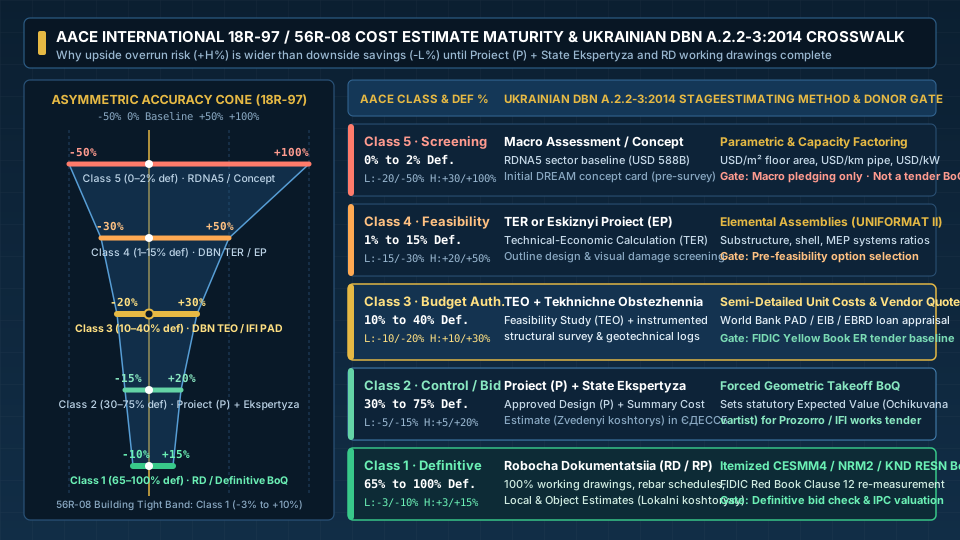
Crosswalk between AACE 18R-97 / 56R-08 and Ukrainian DBN A.2.2-3:2014 design stages
Under Ukrainian construction regulation DBN A.2.2-3:2014 (Composition and Content of Design Documentation for Construction), administered through e-construction.gov.ua (ЄДЕССБ), design progresses through statutory stages tied to consequence class (CC1 minor, CC2 medium, and CC3 significant consequence, covering apartment blocks, hospitals, bridges, and utility plants). Aligning AACE classes with DBN A.2.2-3:2014 stages prevents procuring entities (zamovnyky) from comparing estimates prepared at incompatible levels of technical definition:
| AACE Class | Definition % | Ukrainian DBN A.2.2-3:2014 Stage |
Methodology & Primary Inputs | AACE 18R-97 Accuracy (56R-08 Band) |
Lifecycle Gate |
|---|---|---|---|---|---|
| Class 5 (Screening) | 0%–2% |
Macro (RDNA5) or pre-survey DREAM card |
Parametric ratios (USD/m², USD/km, USD/kW) |
L: -20% to -50%H: +30% to +100%(56R-08: -20/-30%, +30/+50%) |
Macro pledging; not tenderable |
| Class 4 (Feasibility) | 1%–15% |
TER (Tech-Econ Calc) or EP (Outline) |
Elemental assemblies (UNIFORMAT II), visual screening |
L: -15% to -30%H: +20% to +50%(56R-08: -10/-20%, +20/+30%) |
Option screening & IFI Concept Note |
| Class 3 (Appraisal) | 10%–40% |
TEO (Feasibility) + Survey (Obstezhennia) |
Semi-detailed costs from boreholes, NDT, vendor quotes | L: -10% to -20%H: +10% to +30%(56R-08: -5/-15%, +10/+20%) |
IFI Loan Appraisal (PAD) & Yellow Book ER |
| Class 2 (Control / Bid) | 30%–75% |
Proiect (P) + Ekspertyza + ZKR |
Geometric take-offs from P drawings via KND or market rates |
L: -5% to -15%H: +5% to +20%(56R-08: -5/-10%, +5/+15%) |
Budget approval & Prozorro Expected Value |
| Class 1 (Definitive) | 65%–100% |
Robocha Dokumentatsiia (RD) / RP |
Itemized BoQ (CESMM4, NRM2, KND) with 100% rebar take-offs |
L: -3% to -10%H: +3% to +15%(56R-08: -3/-5%, +3/+10%) |
FIDIC Red Book tender & Variations |
Why cost estimate accuracy bands are asymmetrically skewed upward
In every row of AACE 18R-97, the upper overrun bound (+H%) exceeds the downside savings bound (-L%): -50% / +100% at Class 5, -30% / +50% at Class 4, and -20% / +30% at Class 3. Construction costs follow a positively skewed log-normal distribution for three engineering reasons:
- Physical price floors: Structural concrete (
C25/30), reinforcing steel (A400C / A500C), pre-insulated pipes, and craft labor have hard market floors. Efficiency can save5% to 15%, but quantities cannot shrink by80%. - Hidden blast-damage discovery: Early
Class 5andClass 4estimates price visible surfaces. Once intrusive diagnostics (tekhnichne obstezhennia) open a shelled building—as detailed in our panel building repair and energy retrofit explainer—engineers uncover shear fractures in welded panel joints or spalled slab bearings requiring structural stabilization packages. - External utility and hazard interfaces: As shown in our Ukraine housing reconstruction guide and municipal water and district heating grid recovery analysis, early concepts rarely price external power ties, chrysotile asbestos removal, or unexploded ordnance (
UXO) clearance untilClass 3(TEO) orClass 2(Proiect P) design is completed.
Engineering rule of thumb (AACE Maturity Gate): Never allege procurement overpricing by comparing a Class 1 or Class 2 post-Ekspertyza tender price against an earlier Class 5 (RDNA5 or initial DREAM card) figure. If an initial USD 10.00 million Class 5 concept card rises to USD 16.50 million (+65%) after boreholes, blast diagnostics, and state Ekspertyza at Class 2, that shift sits inside the Class 5 -50% / +100% cone and reflects scope discovery rather than price inflation.
Donor-funded project cost structure: physical vs. price contingencies
When a multilateral institution—such as the World Bank under Investment Project Financing (IPF), the EIB, the EBRD, or the EU Ukraine Facility—approves construction project funding, the headline amount in the Project Appraisal Document (PAD) is the Total Project Cost (Total_Project_Cost), not the bare civil works contract. For instance, the World Bank’s Housing Repair for People’s Empowerment (HOPE) Project Appraisal Document (P181200) budgets separate components for engineering assessments, detailed design (Proiect / koshtorys), environmental safeguards (debris and asbestos), project management, and physical repair works. World Bank HOPE PAD P181200.
The 5-part multilateral Total Project Cost equation
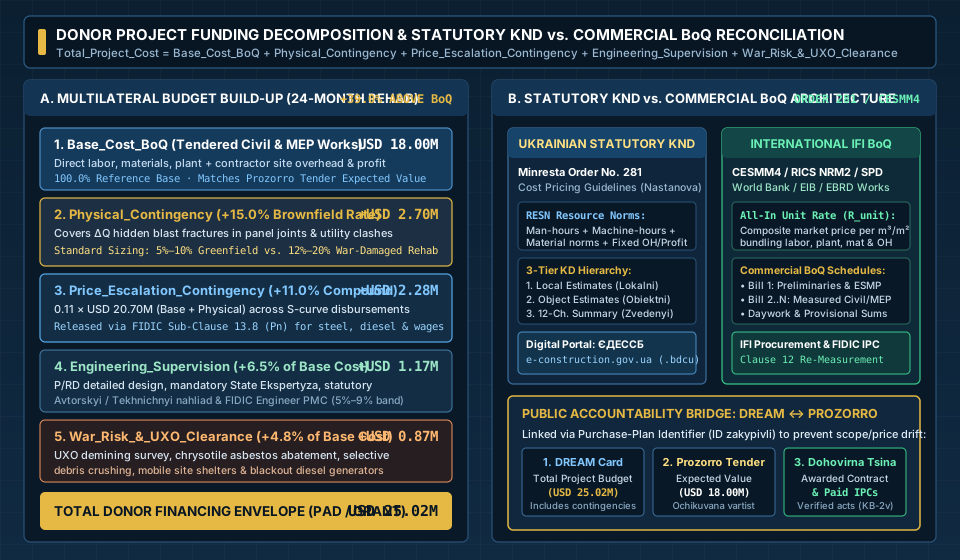
Across multilateral development banks, a donor-funded reconstruction budget follows the five-part additive equation:
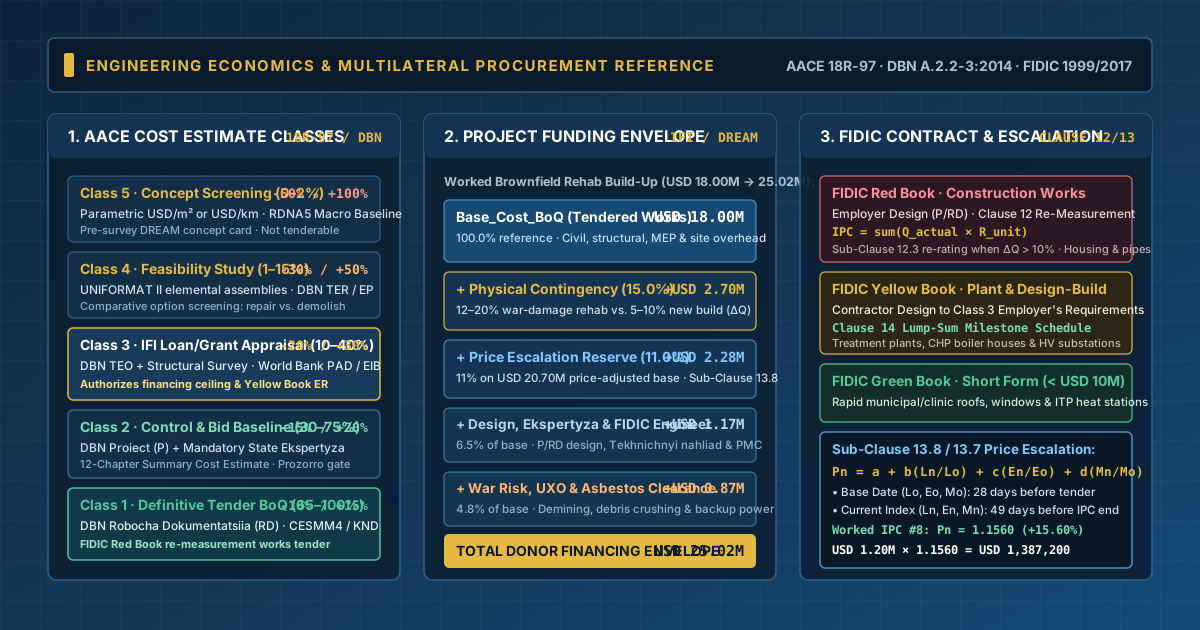
Total_Project_Cost = Base_Cost_BoQ + Physical_Contingency + Price_Escalation_Contingency + Engineering_Supervision + War_Risk_&_UXO_Clearance
Base_Cost_BoQ(Direct & Indirect Works Base Cost at Base-Date Prices): Priced Bill of Quantities (BoQ) schedules for civil, structural, architectural, andMEPworks (labor, materials, and plant), plus preliminaries, mobilization, testing, bonds, overhead, and profit—valued in constant prices as of the Base Date (28 days prior to bid submission).Physical_Contingency(Volume & Technical Uncertainty Reserve,ΔQ): Employer-held reserve covering unforeseen increases in physical quantities (ΔQ) or latent defects discovered within the approved scope during construction, valued at constant Base Date prices.Price_Escalation_Contingency(Macroeconomic Inflation & FX Reserve,ΔP): Financial reserve modeled across the multi-year disbursementS-curveto absorb input inflation (steel, cement, bitumen, copper, diesel, wages) and currency shifts (UAHvs.USD/EUR) between Base Date and monthly execution.Engineering_Supervision(Design, State Ekspertyza, & FIDIC Engineer): Professional services (5.0% to 9.0% of Base_Cost_BoQ) fundingProiect(P) andRDdesign, mandatory State Expertise (Ekspertyza) ine-construction.gov.ua, statutory Author’s (Avtorskyi) and Technical Supervision (Tekhnichnyi nahliad), and the FIDIC Consulting Engineer / PMC.War_Risk_&_UXO_Clearance(Demining, Asbestos, & Continuity Allowance): Dedicated pre-construction and site-resilience funding (4.0% to 12.0% of Base_Cost_BoQon damaged sites). As evidenced in UNDP Ukraine’s clearance of over 1 million tonnes of recovery debris, war-damaged sites requireUXOdemining certification, selective demolition, rubble crushing, regulated abatement of chrysotile asbestos roofing (shyfer) and pipe insulation, blast shelters, and backup generators.
Distinguishing physical contingency (5%–10% vs. 12%–20%) from price escalation contingency
Conflating physical contingency with price escalation contingency causes under-budgeting on brownfield sites:
| Dimension | Physical Contingency (ΔQ Technical Buffer) |
Price Escalation Contingency (ΔP Inflation Buffer) |
|---|---|---|
| Core Risk Covered | Unforeseen work quantities or latent defects at Base Date prices: blast micro-cracking in concrete panels, unmapped utilities, or corroded pipe supports. | Input price inflation over time: craft wage growth, diesel/power tariffs, steel/cement/copper index shifts, and UAH/EUR/USD exchange rates. |
| Greenfield Sizing | 5.0% to 10.0% of Base_Cost_BoQ (~10% at Class 3 appraisal; 5%–7% at Class 1/2 working drawings). |
Compounded across the S-curve (2%–4% p.a. EUR/USD; 8%–15% p.a. UAH), totaling 8.0% to 18.0% over 24–48 months. |
| War-Damage Rehab Sizing | 12.0% to 20.0% of Base_Cost_BoQ due to hidden blast overpressure, fire damage, and freeze-thaw degradation inside unheated structures or mains. |
Compounded across wartime logistics (10.0% to 22.0% cumulative) and tied to official Ukrstat and Eurostat producer price indices. |
| FIDIC Release Gate | Disbursed only upon Engineer-certified re-measured quantities (Clause 12) or Variation Orders (Clause 13). |
Disbursed automatically on each monthly IPC when Pn > 1.00 under Sub-Clause 13.8 / 13.7 (or deducted if Pn < 1.00). |
Worked calculation: reconciling a USD 25.02M donor grant with a USD 18.00M Prozorro tender
Consider an IFI-financed municipal recovery project (Class 3 to Class 2 transition) rehabilitating war-damaged apartment blocks and replacing connecting district-heating mains over a 24-month schedule:
- Direct & Indirect Civil Works Base Cost (
Base_Cost_BoQat Base Date):Base_Cost_BoQ = USD 18.00 million(100.0%reference baseline published as the civil works tender expected value). - Physical Contingency (
15.0%brownfield war-damage rehabilitation rate):Physical_Contingency = 0.15 × USD 18.00M = USD 2.70 millionPrice-Adjusted Works Base = USD 18.00M + USD 2.70M = USD 20.70 million. - Price Escalation Contingency (
11.0%blended multi-year escalation applied to theUSD 20.70Mprice-adjusted base):Price_Escalation_Contingency = 0.11 × USD 20.70M = USD 2.277 million(rounded toUSD 2.28 million; orUSD 1.98 millionon unadjusted Base Cost). - Engineering Design (
P/RD), State Ekspertyza, Technical Supervision & FIDIC Engineer (6.5%ofBase_Cost_BoQ):Engineering_Supervision = 0.065 × USD 18.00M = USD 1.17 million. - War-Risk, UXO Survey, Chrysotile Asbestos Abatement & Debris Management (
4.8%ofBase_Cost_BoQ):War_Risk_&_UXO_Clearance = 0.048 × USD 18.00M = USD 0.864 million(rounded toUSD 0.87 million). - Total Donor Project Financing Envelope (
Total_Project_Cost):Total_Project_Cost = 18.00 + 2.70 + 2.28 + 1.17 + 0.87 = USD 25.02 million(+39.0%aboveBase_Cost_BoQ).
Conditional calculation note & verification rule: In this decomposition, the USD 25.02 million headline figure in a donor financing agreement or DREAM overview and the USD 18.00 million civil works tender expected value (ochikuvana vartist) in Prozorro describe the same project with zero missing funds. The USD 7.02 million (+39.0%) difference comprises separately procured engineering and UXO/debris contracts (USD 2.04M) plus unallocated physical and inflation reserves (USD 4.98M) held until certified variations or index escalation occur. Always check whether 20% Ukrainian VAT (PDV), import duties, contingencies, and supervision sit inside or outside a quoted figure before comparing amounts.
Ukrainian statutory costing (KND / Nastanova) vs. international commercial BoQs
Donor-financed projects in Ukraine bridge two cost-engineering regimes:
- Ukrainian Statutory Resource-Norm Costing (
KND/ Nastanova): Governed by the Cost Pricing Guidelines (Настанова з визначення вартості будівництва), enacted by Minresta Order No. 281 of 01 November 2021 (replacingDSTU B D.1.1-1:2013). Public projects upload a three-tier statutory estimate (koshtorysna dokumentatsiia) in.bdcu/.imdXML format toe-construction.gov.ua(ЄДЕССБ). - International Commercial Bills of Quantities (
BoQ): Used by the World Bank,EIB, andEBRDunder the World Bank Standard Procurement Document for Works and structured underCESMM4orRICS NRM2.
Structural comparison: Minresta Order No. 281 (KND) vs. International CESMM4 / NRM2 BoQ
| Costing Feature | Ukrainian Statutory KND (Order No. 281 / ЄДЕССБ) |
International Commercial BoQ (CESMM4 / NRM2 / SPD) |
|---|---|---|
| Governing Rule & Registry | Minresta Order No. 281 (01.11.2021) Nastanova + RESN norms. Uploaded to e-construction.gov.ua for Ekspertyza. |
World Bank / EIB / EBRD Rules + CESMM4 or NRM2, tracked across IFI portals, Prozorro, and DREAM. |
| Unit Rate Structure | Normative Resource Disaggregation: Splits each item into man-hours, machine-hours, and material norms (RESN) plus formulaic overhead, admin, and profit. |
All-In Composite Unit Rate (R_unit): Each BoQ item (e.g., "Pre-insulated pipe DN 300 in trench, per m") carries one composite price bundling labor, plant, materials, overhead, and profit. |
| Estimate Hierarchy | 3-Tier Hierarchy: Local (Lokalni), Object (Obiektni), and 12-Chapter Summary Cost Estimate (ZKR: Ch. 1–9 works, Ch. 10 supervision/Ekspertyza, Ch. 11 training, Ch. 12 design). |
Commercial Schedule Hierarchy: Bill 1 Preliminaries (mobilization, bonds, insurance, ESMP, UXO), Bills 2..N Measured Works, Daywork, and Grand Summary. |
| Monthly Payment Audit | Requires Form No. KB-2v and Form No. KB-3, audited against resource norms and invoices. | Certified via a monthly FIDIC Interim Payment Certificate (IPC) (Q_actual × R_unit under Clause 12/14, plus Pn). |
| Wartime Hybrid Practice | Rigid norms lag wartime wages and imported plant costs, causing tenders to fail when expected value sits below market rates. | Order No. 281 and IFI loans procure commercial BoQ rates (Dohovirna tsina) while registering P design and Ekspertyza in ЄДЕССБ. |
Following the project cost trail across e-Construction, DREAM, and Prozorro
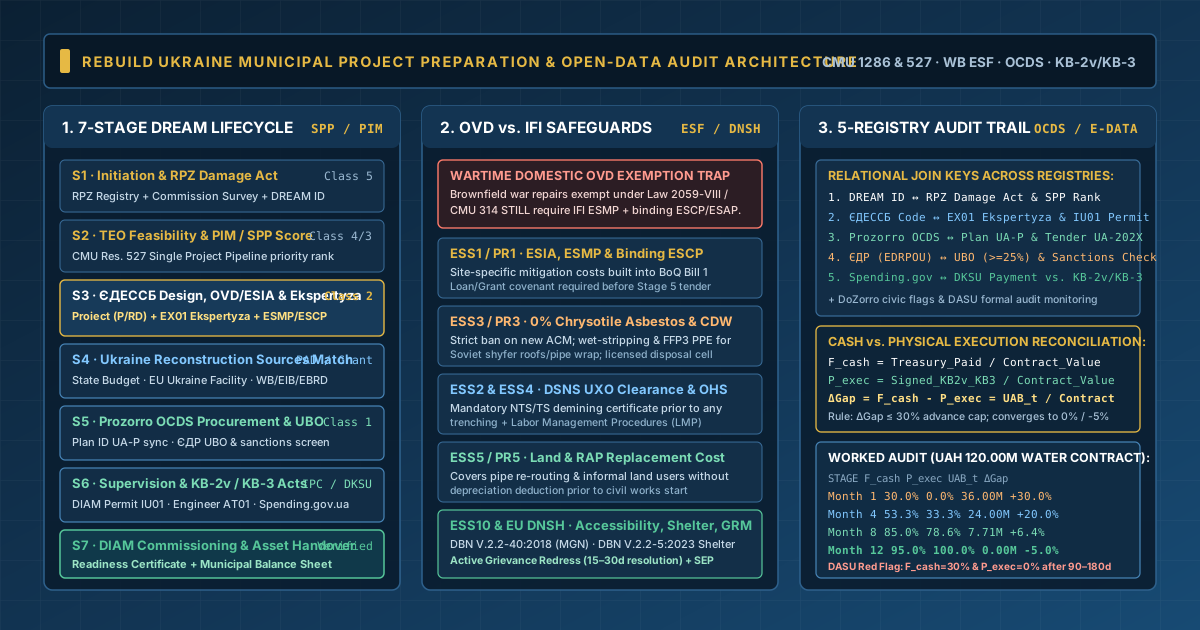
Since 2024, Ukraine’s DREAM platform integrates directly with Prozorro via the purchase-plan identifier (ідентифікатор плану закупівлі). DREAM Prozorro integration documentation. This link lets readers audit four sequential records side by side: (1) the initial DREAM project budget (Class 5/4 concept or Class 2 ZKR total after Ekspertyza in e-construction.gov.ua), (2) the Prozorro tender expected value (ochikuvana vartist for the works lot), (3) the awarded contract price (dohovirna tsina), and (4) cumulative disbursements paid against certified KB-2v acts or FIDIC IPCs. For the complete seven-stage DREAM workflow, Single Project Pipeline (SPP) prioritization scoring, environmental safeguard crosswalks, and State Treasury versus KB-2v / KB-3 payment reconciliation, see our Rebuild Ukraine project preparation and transparency reference.
FIDIC reconstruction procurement: Red Book, Yellow Book, Silver Book, and Green Book
When multilateral lenders (World Bank, EIB, EBRD, NEFCO) finance Ukrainian recovery works, contracts follow the FIDIC Rainbow Suite published by the International Federation of Consulting Engineers (FIDIC, 1999 and 2017 Editions) and embedded in the World Bank Standard Procurement Document for Works.
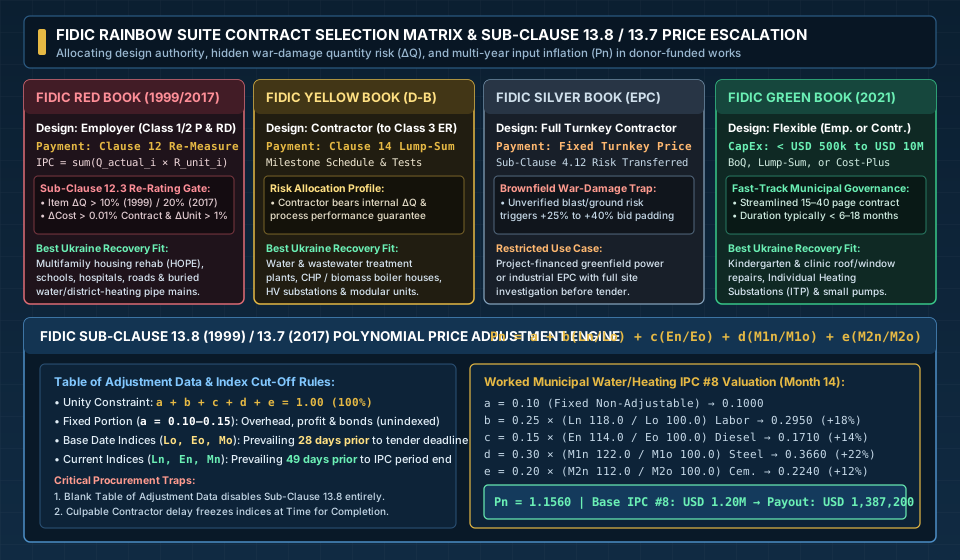
Selecting the wrong FIDIC book for war-damaged infrastructure triggers predictable failures: forcing a turnkey lump-sum contract onto a shelled building whose structural joints cannot be inspected before demolition causes rational bidders either to walk away or to add a 25% to 40% risk premium. Conversely, using an item-by-item re-measurement contract for a proprietary water-treatment or CHP plant splits process-performance accountability between the municipal designer and the equipment vendor.
FIDIC Rainbow Suite selection matrix for Ukraine recovery projects
| FIDIC Contract | Design Authority & Stage | Valuation & Payment Mechanism | Quantity (ΔQ) & Ground Risk |
Ukraine Recovery Fit |
|---|---|---|---|---|
| 1. Red Book (Construction, 1999/2017) |
Employer (Class 1/2 Proiect P + Ekspertyza and RD drawings before tender). |
Re-Measurement (Clause 12): Unit rates (R_unit) in BoQ; IPC = sum(Q_actual × R_unit). |
Employer bears ΔQ and unforeseeable ground risk (Sub-Clause 4.12). |
Housing rehab (HOPE), schools, hospitals, roads, and buried water/heating mains. |
| 2. Yellow Book (Plant & D-B, 1999/2017) |
Contractor (designs P & RD and passes Ekspertyza to meet Class 3 ER). |
Lump-Sum (Clause 14): Paid against a Milestone Schedule (design, tests, erection, commissioning). |
Contractor bears internal ΔQ and process guarantee; Employer holds Sub-Clause 4.12 risk. |
Water/wastewater plants, CHP/biomass boilers, substations, and modular housing. |
| 3. Silver Book (EPC / Turnkey, 1999/2017) |
Contractor (Turnkey): Total design, procurement, construction, and site verification (Sub-Clause 5.1). |
Fixed Turnkey Lump-Sum (Clause 14): High price certainty at a higher bid premium. |
Contractor bears almost all subsurface and quantity risks (Sub-Clause 4.12). |
Greenfield power/industrial EPC only; unsuitable for war repair (+25%–40% bid padding). |
| 4. Green Book (Short Form, 1999 / 2021) |
Flexible: Concise (15–40 page) contract for simple or repetitive works. |
Flexible: Supports BoQ re-measurement, lump-sum milestones, or cost-plus. |
Balanced risk sharing with rapid adjudication and low PIU overhead. |
Rapid municipal repairs (< USD 500k to USD 10M, < 6–18 mo): roofs, windows, clinics, ITP stations. |
How FIDIC Red Book Clause 12 re-measurement and Sub-Clause 12.3 rate revision work
Under FIDIC Red Book (Clause 12: Measurement and Evaluation), quantities in the tender Bill of Quantities (Q_tender) are estimates only. The Engineer measures the actual net physical quantity (Q_actual) executed on site and values each monthly IPC by multiplying Q_actual by the contracted unit rate (R_unit):
Valuation_Item_i = Q_actual_i × R_unit_i
Suppose a Proiect (P) survey of a blast-damaged 9-story panel building estimates that 180 linear meters of load-bearing panel joints require structural grouting and steel plate reinforcement (R_unit = USD 420/m, estimated total USD 75,600). Once damaged insulation and plaster are stripped, joint-by-joint inspection shows 245 linear meters (+36.1%) require stabilization. Under the Red Book, the contractor is paid for the measured 245 m × USD 420/m = USD 102,900, and the extra USD 27,300 (65 m × USD 420/m) is funded from Physical Contingency without contract renegotiation.
If a quantity variance is so large that the tendered unit rate (R_unit) under- or over-recovers fixed mobilization and equipment overhead, FIDIC Sub-Clause 12.3 (Evaluation, 1999 Edition) sets a four-part cumulative threshold gate before a revised unit rate (R_new) can be fixed:
Q_actualdiffers fromQ_tenderby more than10%(|Q_actual - Q_tender| / Q_tender > 0.10;> 20%in 2017 Edition); AND- The difference times
R_unit(|Q_actual - Q_tender| × R_unit) exceeds0.01%of the Accepted Contract Amount; AND - The quantity change directly alters the Cost per unit of that item by more than
1%; AND - The item is not designated in the Contract as a “fixed rate item”.
Price escalation math: FIDIC Sub-Clause 13.8 / 13.7 polynomial formula
Ukrainian reconstruction contracts frequently span 18 to 42 months. Forcing contractors to bid fixed prices over multi-year timelines causes cancelled Prozorro tenders or forces bidders to embed worst-case inflation premiums on Day 1. To protect both the public budget and contractor cash flow, the World Bank Standard Procurement Document for Works incorporates FIDIC Sub-Clause 13.8 (Adjustments for Changes in Cost, 1999 Edition / Sub-Clause 13.7 in 2017). Each monthly IPC is multiplied by the polynomial price adjustment factor (Pn):
Pn = a + b × (Ln / Lo) + c × (En / Eo) + d × (M1n / M1o) + e × (M2n / M2o) + ...
Exact variable definitions and statutory index cut-off dates
All parameters are locked in the tender’s Table of Adjustment Data:
Pn(Price Adjustment Multiplier for Periodn): Dimensionless multiplier applied to the base-rate value of work executed in periodn(Adjusted_IPC_n = Base_IPC_n × Pn, or net escalationΔIPC_n = Base_IPC_n × (Pn - 1.00)).a(Fixed Non-Adjustable Coefficient): Fixed decimal (0.10 to 0.15, or10%–15%) for overhead, profit, and bond costs not subject to indexation.b, c, d, e, ...(Cost Weighting Coefficients): Decimal weights for each input basket—Skilled Labor (b), Equipment & Diesel (c), Reinforcing Steel / Pre-insulated Pipe (d), and Portland Cement / Concrete (e).- Mandatory Unity Normalization Constraint: In each currency column, the coefficients sum to unity:
a + b + c + d + e + ... = 1.00 Lo, Eo, M1o, M2o(Base Date Cost Indices): Official indices on the Base Date, defined in FIDIC Sub-Clause 1.1.3.1 as28 days prior to the tender submission deadline.Ln, En, M1n, M2n(Current Period Cost Indices): Official indices on the date49 days prior to the last day of the billing period(Ukrstatindices forUAHportions;Eurostat/Destatisindices forEUR/USDimported portions).
Worked calculation: evaluating IPC #8 price escalation on a municipal water and heating contract
A municipal water and heating contract under the FIDIC Red Book defines five coefficients summing to 1.00 (0.10 + 0.25 + 0.15 + 0.30 + 0.20 = 1.00). Fourteen months after the Base Date (Bid - 28d), the Engineer certifies Interim Payment Certificate IPC #8 for USD 1,200,000 of measured Clause 12 works:
| Basket & Symbol | Weight (w_i) |
Base (Xo Bid-28d) |
Current (Xn IPC-49d) |
Ratio (Xn/Xo) |
Contribution (w_i × Xn/Xo) |
|---|---|---|---|---|---|
a — Fixed Non-Adjustable |
0.10 |
1.000 |
1.000 |
1.0000 |
0.1000 |
b — Skilled Labor (L) |
0.25 |
Lo = 100.0 |
Ln = 118.0 |
1.1800 (+18%) |
0.2950 |
c — Plant & Diesel (E) |
0.15 |
Eo = 100.0 |
En = 114.0 |
1.1400 (+14%) |
0.1710 |
d — Steel & Pipe (M1) |
0.30 |
M1o = 100.0 |
M1n = 122.0 |
1.2200 (+22%) |
0.3660 |
e — Cement & Concrete (M2) |
0.20 |
M2o = 100.0 |
M2n = 112.0 |
1.1200 (+12%) |
0.2240 |
Total Multiplier (Pn) |
1.00 |
— | — | +15.60% |
Pn = 1.1560 |
Step-by-step arithmetic for IPC #8:
- Normalization:
0.10 + 0.25 + 0.15 + 0.30 + 0.20 = 1.00. - Compute
Pn:Pn = 0.10 + 0.25 × (118.0 / 100.0) + 0.15 × (114.0 / 100.0) + 0.30 × (122.0 / 100.0) + 0.20 × (112.0 / 100.0)Pn = 0.1000 + 0.2950 + 0.1710 + 0.3660 + 0.2240 = 1.1560. - Adjusted
IPC #8payout:Adjusted_IPC_8 = USD 1,200,000 × 1.1560 = USD 1,387,200Net_Escalation_Payment (ΔIPC_8) = USD 1,387,200 - USD 1,200,000 = USD 187,200(+15.60%).
The USD 1,200,000 base valuation is debited against Base_Cost_BoQ, while the USD 187,200 escalation payout is drawn from Price Escalation Contingency (Line 3 in our USD 25.02M decomposition), keeping the contract solvent without altering base unit rates (R_unit).
Three critical procurement failure modes under FIDIC Sub-Clause 13.8 / 13.7
- The Blank Table of Adjustment Data Trap: Under
Sub-Clause 13.8, if the Table of Adjustment Data is left blank in tender documents, the price adjustment clause does not apply. Omitting index sources and weights on a multi-year contract forces 100% of wartime inflation onto the contractor, triggering cancelled tenders or stalled sites. - The Contractor Culpable-Delay Index Freeze Rule: If the contractor fails to finish within the Time for Completion (without a
Sub-Clause 8.4Extension of Time),Pnfor work performed after completion uses whichever index favors the Employer: either the index49 days prior to the expired Time for Completionor the current index (Ln, En, Mn). - No Double-Counting with Current-Price Variations (
Sub-Clause 13.7): Extra works or Daywork valued at current market prices are excluded fromPn, and cost increases compensated viaSub-Clause 13.8indexation cannot be claimed again underSub-Clause 13.7.
Pre-tender and contract audit checklist for donor-funded projects
When preparing a municipal tender package or cross-checking project records across DREAM, Prozorro, and e-construction.gov.ua, verify six sequential gates:
- Tag the AACE Class and
DBN A.2.2-3:2014stage: Confirm whether the figure is aClass 5concept (RDNA5or un-surveyedDREAMcard,-50% / +100%), aClass 3TEOappraisal (-20% / +30%), or aClass 2 / Class 1Proiect(P) /RDestimate backed by a state Ekspertyza certificate inЄДЕССБ. - Confirm intrusive structural and utility diagnostics: Before tendering works on a damaged building or network, verify completion of a Technical Survey (Tekhnichne obstezhennia), matching our panel building rehabilitation explainer and municipal water and district heating grid recovery analysis.
- Separate
Base_Cost_BoQfrom the 4 non-works donor budget lines: Reconcile the35%–45%spread betweenTotal_Project_CostandBase_Cost_BoQacross physical contingency (12%–20%brownfield vs.5%–10%greenfield), compound price escalation (Pn), design/Ekspertyza/FIDIC supervision (5%–9%), andUXO/asbestos/debris clearance (4%–12%). - Verify VAT (
20% PDV) and customs duty treatment: Confirm whether quotedDREAMandProzorrofigures include or exclude20%Ukrainian VAT (PDV), as international grants and multilateral loans often carry statutory tax exemptions. - Match the FIDIC Book to design maturity and ground risk: Pair Employer-designed
P/RDdrawings on buildings, roads, and buried trenches with FIDIC Red Book (Clause 12re-measurement); pair performance-specified process plants (water treatment, CHP boilers, substations) atTEOstage with FIDIC Yellow Book (Clause 14lump-sum milestones); and use FIDIC Green Book (2021 Short Form) for rapid municipal repairs underUSD 10 million. - Audit the Table of Adjustment Data before tender publication: Verify that
a + b + c + d + ... = 1.00, check thatUkrstatandEurostatindices match the payment currency, and enforce the28-dayBase Date and49-dayIPC cut-off rules.
Scope and calculation notes
This reference synthesizes the AACE 18R-97 / 56R-08 classification standard, the World Bank Standard Procurement Document for Works, the FIDIC Rainbow Suite contract conditions, the February 2026 RDNA5 Main Report, the World Bank HOPE Project Appraisal Document (P181200), Ukrainian costing rules under Minresta Order No. 281 and DBN A.2.2-3:2014 in e-construction.gov.ua, DREAM’s Prozorro integration, and UNDP Ukraine’s debris management records. The USD 18.00 million to USD 25.02 million budget decomposition and the USD 1,200,000 IPC #8 escalation (Pn = 1.1560) are conditional calculation examples applying those published formulas to representative municipal parameters. For broader context on how equipment deliveries connect to working utility systems, see our Ukraine infrastructure recovery guide and browse all sector coverage on the reconstruction explainers index.
Updated: 26 October 2026.