Insulating a damaged panel building before its structure is assessed can leave housing rehabilitation with a finished surface over an unresolved failure. The retrieved records keep three decisions apart: a panel-building study of structural stability, a HOPE appraisal path from engineering assessment to repair design, and the World Bank’s September 2015 estimate of 276 kWh/m2 for Ukraine’s existing residential stock, which is historical context rather than a measured retrofit of one panel building. A lower energy figure does not show that a damaged joint is safe, and the Ukraine housing reconstruction guide keeps those repair stages linked.
Quick specifications: keep the performance figure in its printed units
The World Bank’s September 2015 paper prints specific heat-energy consumption estimates for existing residential buildings. These figures establish historical context, without identifying an individual panel building’s performance. The cited paragraph does not print a time denominator, so the units below retain its wording rather than silently adding “per year.” World Bank, printed page 8, first bullet and footnote 1.
| Input or item | Typical value or source | Why it matters |
|---|---|---|
| Ukraine existing residential stock | Estimated range 145-327 kWh/m2, September 2015 paper, p.8 | A stock range, not a panel-building acceptance limit |
| Ukraine national average | 276 kWh/m2, same paragraph | Historical estimate, not a current meter reading |
| Poland comparator | 160 kWh/m2, same paragraph | Different national stock, not the renovated state of the same building |
| Underlying attribution | Ukraine: draft National Energy Efficiency Action Plan through 2020; Poland: ODYSSEE-MURE, footnote 1 | Identifies where the paper obtained its comparison |
| Panel-specific saving or U-value | Not established by these figures | Requires evidence for the actual building and proposed measures |
Repair and energy retrofit answer different questions
The structural question concerns the building’s stability and the work needed to address damage. An energy measure concerns heat demand or system performance; it does not establish structural adequacy. Hryhorovskyi and colleagues’ study, published on 30 October 2022, develops a BIM-based assessment and stabilization approach for large-panel buildings. Its demonstration case concerns a gas explosion, so it should not be presented as a measured energy retrofit or a war-damage performance trial. Study abstract and assessment discussion.
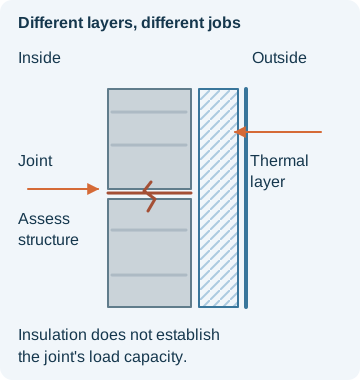
Conceptual section: structural joints and an insulation layer perform different roles. The drawing gives no joint capacity or insulation specification.
| Work category | Evidence it should identify | Dominant Failure Mode & Prevention |
|---|---|---|
| Structural assessment and stabilization | Damage, structural system, joints, required intervention and monitoring | A load-path problem can remain behind new finishes; establish the structural condition and designed intervention first |
| Roof, window or envelope repair | Damaged element and completed repair scope | A repaired surface can leave interfaces unresolved; record the boundaries and acceptance of the repair |
| Envelope energy retrofit | Thermal design, continuity and defined performance basis | Discontinuous treatment can leave heat-loss paths; assess the building envelope as a connected design |
| Heating-system improvement | System design, controls, commissioning and service boundary | An envelope measure alone cannot establish controllable heat delivery; document the system work separately |
This comparison is an editorial interpretation of the panel-study assessment approach and the August 2023 HOPE appraisal, printed page 19, paragraphs 32-33 and footnote 35. It does not classify a particular building.
The HOPE capital-repair design makes engineering assessments and project documentation prerequisites for works. It separately names studies of structural and non-structural performance. Its energy discussion includes insulation, windows, heating/cooling systems and lighting. Those are design categories; the passage supplies no fixed saving for every repaired building. This describes the project at appraisal, rather than today’s assistance eligibility.
A stock comparison cannot become a retrofit saving
The printed national averages compare different building stocks. They are not before-and-after observations of one repaired panel building. A quotient can describe the published comparison, provided it keeps that boundary.
Stock comparison ratio = printed Ukraine average / printed Poland comparator.
Worked example: 276 kWh/m2 / 160 kWh/m2 = 1.725, or approximately 1.73. This is an editorial calculation using the September 2015 paper’s page 8 inputs; the paper does not print this quotient. It is dimensionless and retains the source’s unspecified time basis. It does not establish an achievable saving, an annual bill or a target for a Ukrainian building.
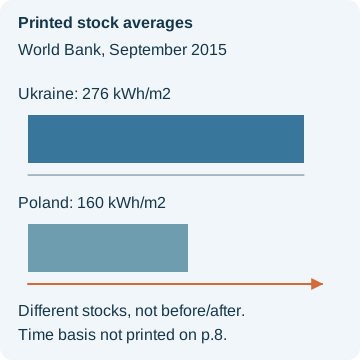
September 2015 stock context, not panel-building measurements. The source paragraph prints kWh/m2 without a time denominator.
Evidence threshold rule: a claimed baseline below 145 kWh/m2 or above 327 kWh/m2 needs building-specific evidence rather than extrapolation from this historical range. This editorial rule uses the limits printed on page 8 of the September 2015 paper. Values inside the range also require verification; the range is neither a safety threshold nor a compliance band.
For any claimed improvement, identify the energy service measured, heated floor area, reporting period, weather treatment and indoor conditions. A smaller energy total during interrupted heating cannot by itself establish better building efficiency. If structural adequacy remains unresolved, the acceptable scope and added loads of retrofit work also remain unresolved.
Follow the cost and service boundaries
Housing rehabilitation includes work outside the visible insulation layer. Project reporting should distinguish structural investigation and repair, access and scaffolding, weather protection, envelope details, heating controls, commissioning and maintenance. These are cost categories to check in the actual scope; the retrieved sources do not supply a universal price or payback for them.
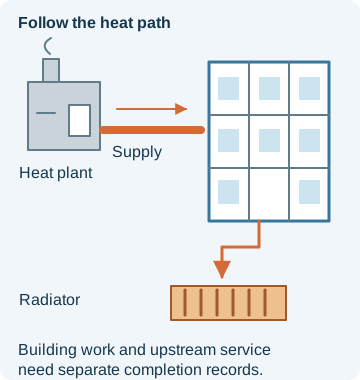
Heat-path schematic: upstream service and work inside the building have separate boundaries. No capacity or operating result is assigned.
The infrastructure recovery guide explains the networks around a dwelling. The housing guide sets the other boundary: a repair or retrofit record does not determine whether services, security and household circumstances support return. A completed contract, a modeled energy measure and an occupied home should remain distinct claims.
Method and sources
This article separates the retrieved panel-building research, the World Bank’s HOPE project design and its older energy-finance paper. It preserves printed units and source dates, labels the quotient as editorial arithmetic, and infers no individual building’s performance. Primary originals were retrieved after the library search. Ukraine Rebuild Review is an independent publication; this analysis does not provide building acceptance or assistance eligibility decisions.
Updated: 19 October 2026. Sources retrieved: 19 October 2026.