A delivered modular shelter can still leak heat through its envelope or lose winter protection when heating and services stop. Temporary housing solutions here mean Better Shelter’s Relief Housing Unit adaptation for Ukraine, where insulation and heating are one package: the cold-climate file’s slide 16 prints 100 mm stone wool on the walls and roof, 50 mm floor insulation, a 2100 W heater, a closed-chamber difference of 37 C, and a separate field estimate of around 28 C. UNHCR’s 2023-2024 winter plan adds insulation, heaters and collective-site maintenance without an occupancy decision for a named household, and neither record certifies a dwelling; the wider repair context stays in the Ukraine housing reconstruction guide.
Quick specifications: what the retrieved document prints
The numbers below describe the RHU chamber adaptation and the manufacturer’s estimate, rather than a specification for all modular accommodation. The technical file name identifies May 2024; the deck includes later examples but gives no formal publication date or date for the chamber test. Better Shelter, slide 16.
| Input or item | Typical value or source | Why it matters |
|---|---|---|
| Test shelter floor area | 17.5 m2, slide 16 | Establishes the unit behind the heater figure |
| Heater in that test | 2100 W, slide 16 | A stated test input, not a universal heater requirement |
| Chamber adaptation | 100 mm stone wool on walls and roof; 50 mm floor insulation and 15 mm plywood, slide 16 | The result belongs to this assembly |
| Chamber conditions | Air lowered to -20 C; all ventilation openings closed; no soil or wind effects, slide 16 | Occupied, ventilated outdoor use has different conditions |
| Reported chamber temperature difference | 37 C with insulation and the 2100 W heater, slide 16 | A difference between inside and outside, not an indoor setpoint |
| Estimated field temperature difference | Around 28 C with 2100 W; example -15 C outside and +13 C inside if properly built, slide 16 | An estimate printed separately from the chamber result |
| Other performance data | No U-value, airtightness class or heat-trace load established by this passage | Those values remain unknown |
Winter protection is a package, not a panel label
The deck pairs reduced heat loss with a heat source and draws attention to moisture and fire risks. Its Ukraine adaptation includes a raised floor, insulation, protective sheeting and details around openings. These are parts of a specific design, rather than evidence that a container or prefabricated unit is winter-ready by name alone. Better Shelter, slides 6 and 15-17.
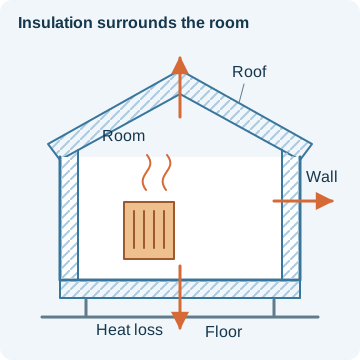
Envelope schematic: heat can leave through different surfaces. It shows the relationship described in the deck, without assigning a heat-loss rate.
| Documented measure | What it addresses | Dominant Failure Mode & Prevention |
|---|---|---|
| Wall, roof and floor insulation | Heat transmission through the enclosure | Water entering insulation impairs its function; the deck stresses moisture protection and attention to coverings |
| Heating | Adds heat to balance losses | Fire and combustion-fume risks require a suitable design and risk evaluation; a heater rating alone cannot establish safe use |
| Openings and ventilation details | Heat exchange and necessary air movement | Copying a closed-vent chamber condition into occupancy would omit a real operating condition; retain ventilation in the professional assessment |
| Collective-site maintenance | Condition of the occupied building and its systems | Small repairs alone do not establish heating or electrical reliability; UNHCR’s plan treats system maintenance as separate work |
The first three rows interpret Better Shelter, slides 6, 16 and 17. The collective-site scope comes from UNHCR’s September 2023 plan, page 2, a historical programme description.
Threshold rule: below freezing, the manufacturer says both insulation and heating are likely to be required. Treat an insulation-only winter claim as incomplete evidence under that condition. This is the warning on slide 6, not a heater-sizing rule or an instruction to alter a shelter.
The field estimate does not inherit the chamber conditions
The deck explicitly lowers its estimated temperature difference for field use because the chamber lacked soil and wind effects. It also says opening the door or ventilating would require more heating capacity than the stated test heater. Those qualifications belong beside the number whenever it is repeated. Better Shelter, slide 16.
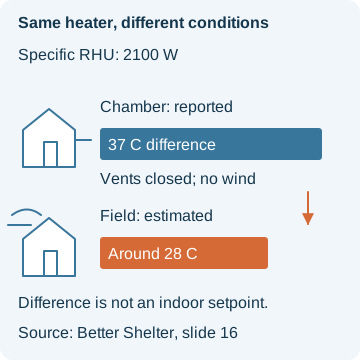
The same slide reports a chamber result and a lower field estimate. Neither bar is a measured outcome for an occupied Ukrainian household.
A useful calculation describes the test input without turning it into a promise:
Installed heater rating per floor area = heater rating / shelter floor area.
Worked example: 2100 W / 17.5 m2 = 120 W/m2. This is an editorial calculation from the inputs on slide 16 of the retrieved 2024-file deck; the source does not print this quotient. It expresses rated heater power per unit floor area. It is neither measured energy consumption nor a heat-loss coefficient, and it cannot size a heater or electrical supply for another unit.
A warm shell and working services need separate evidence
UNHCR’s Ukraine Winterization Plan 2023-2024 distinguishes thermal kits and insulation from heaters and maintenance of collective-site heating and electrical systems. Its thermal-kit description names reflective screens, plastic sheeting, draft blockers and tape, without assigning those items a measured temperature gain. UNHCR, page 2; document footer dated 15 September 2023.
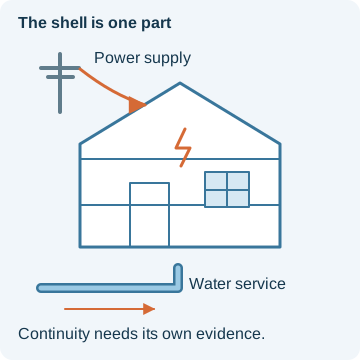
Service-dependency schematic: the shell, power and water are separate evidence questions. The drawing assigns no service capacity or freeze-protection specification.
For reporting on a project, distinguish the costs and responsibilities for the shell, insulation protection, heat supply, energy, repairs and ongoing maintenance. A delivered unit or an insulation invoice does not document all of them. Water-service protection and continuity likewise require site-specific records; neither retrieved passage establishes a pipe-protection design.
The boundary is the household’s actual situation: site conditions, accepted works, service availability and individual needs remain unresolved by these documents. The live housing guide explains why repair completion and return are separate questions. The Ukraine Rebuild Review homepage connects housing to the wider recovery coverage.
Method and sources
This explainer uses the retrieved Better Shelter technical deck and UNHCR’s historical Ukraine winter plan. Manufacturer results are identified as such, estimates remain estimates, and no household outcomes are inferred. The library search was supplemented by retrieval of the primary originals. This independent publication provides documentary analysis, not accommodation allocation or assistance eligibility advice.
Article date: 18 October 2026. Source retrieval: 19 October 2026.