
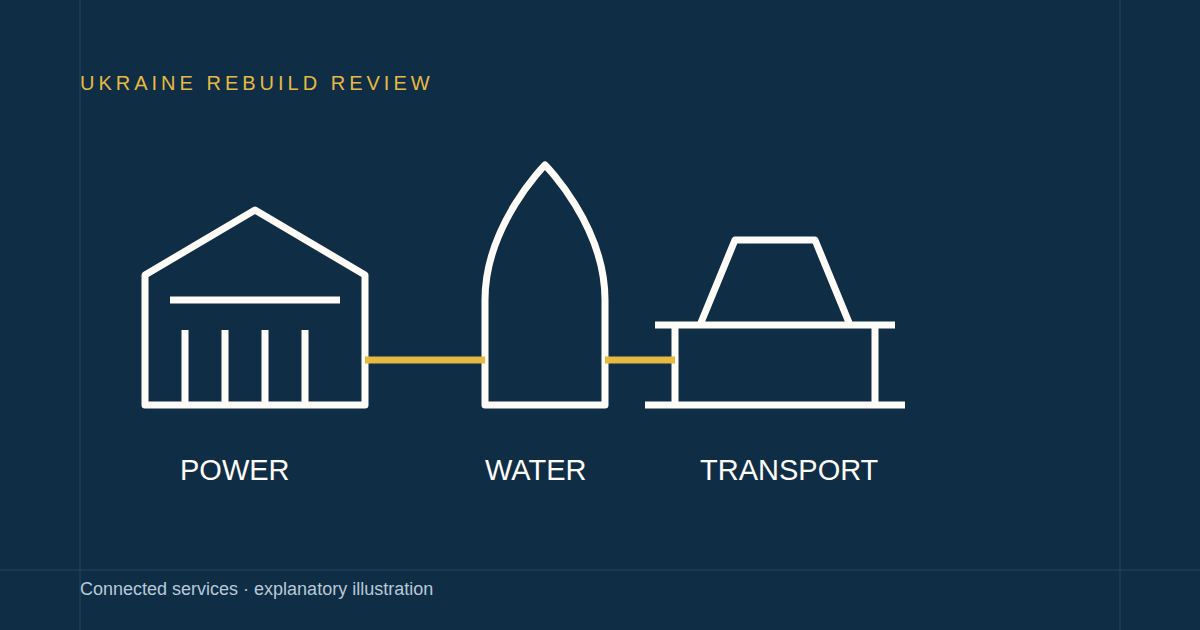
Ukraine’s infrastructure recovery is already happening through repairs, equipment installation and the restoration of connections. To understand an announcement, start with the service it concerns: electricity available to users, water delivered, heat supplied or a route reopened.
Those outcomes require more than an asset arriving at a site. They also depend on other networks, technical work and an operator able to keep the service running. Reading recovery through these connections makes it easier to distinguish progress from a project’s intended result.
Power recovery supports several services
UNDP’s Green Energy Recovery Programme describes equipment procurement, installation support and training for service providers. It also identifies reliable electricity as a condition for hospitals, water treatment facilities and other essential services to function. Its programme goals include energy efficiency and longer-term changes alongside urgent repairs. UNDP programme description.
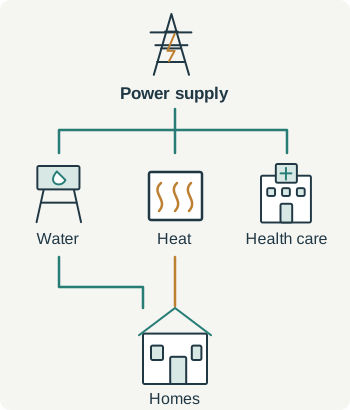
For readers, the implication is to examine the service chain. In a hypothetical town, a repaired water pipe might still need a functioning electrically powered pumping system before normal supply can resume. A report about the pipe and a report about water reaching households would answer different questions.
The same caution applies to geographic scope. Restoring supply to one facility does not establish that the surrounding network has recovered. A useful account identifies the facility or area served, the reporting period and the level of service achieved. Claims of reliability also need a stated observation period; a successful test and sustained operation provide different evidence.
Delivered equipment still needs installation and testing
On 29 September 2026, Ukraine’s Ministry of Energy and UNDP announced the Ukraine Energy Installation Facility. The announcement explicitly addresses the gap between contributed equipment and operational infrastructure. It sets out planned work including engineering assessments, site preparation, installation, grid connection, commissioning and quality assurance. Original UNDP announcement.
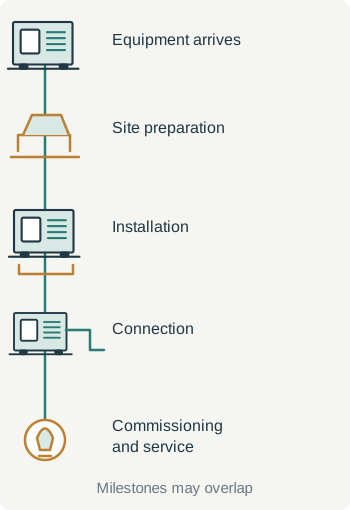
The facility’s launch documents an institutional response to that problem. It does not establish that all the equipment within its intended scope has been commissioned.
An announcement that a generator or transformer has been delivered can accurately report a milestone. To interpret its effect, look next for installation and connection records, testing or commissioning evidence, and a dated account from the service operator. These records help establish what the equipment is doing, where it operates and which users it serves. They should be read against the project’s stated scope rather than a general expectation that one unit restores a whole system.
Transport recovery concerns connections
The value of a repaired road or rail asset depends partly on the routes it connects. A bridge can be a critical link between settlements, a repair base and the rest of a network. Counting assets without their function can therefore miss the importance of a particular repair.
The World Bank’s 21 January 2025 account of its Repairing Essential Logistics Infrastructure and Network Connectivity project, RELINC, describes support for critical rail and road connections and Danube port operations. It reports the use of modular bridges and repair equipment to restore damaged railway links. This is a dated example of recovery during the war, rather than a statement that Ukraine’s transport network has been fully restored. World Bank RELINC account.
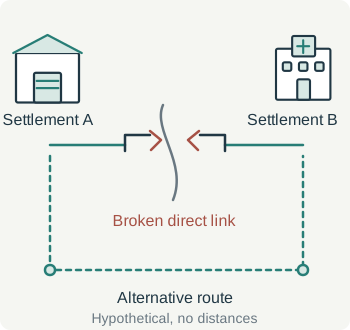
For a transport project, ask which connection reopened, what traffic it can carry and whether the result is temporary or intended as a lasting reconstruction. A route reopening is useful evidence of access; it does not by itself measure freight capacity across a whole corridor.
Match the record to the claim
Project records provide another route into the evidence. DREAM’s official explanation of its Prozorro integration describes links to procurement procedures, estimated and contracted values, contract status, and delivery and payment information. Such records help identify what a contract covers. They still need to be compared with evidence of the resulting service. DREAM integration explanation.
When reading a recovery update, keep the asset, location, delivery stage and observation date together. Then ask whether the source reports an expected result, completed work or measured operation. That distinction is more useful than treating every announcement as a comparable unit of progress.
The housing reconstruction guide connects these services to neighbourhood recovery. The funding guide explains how financing and procurement records fit together. See our sources page for the approach behind these independent explainers.