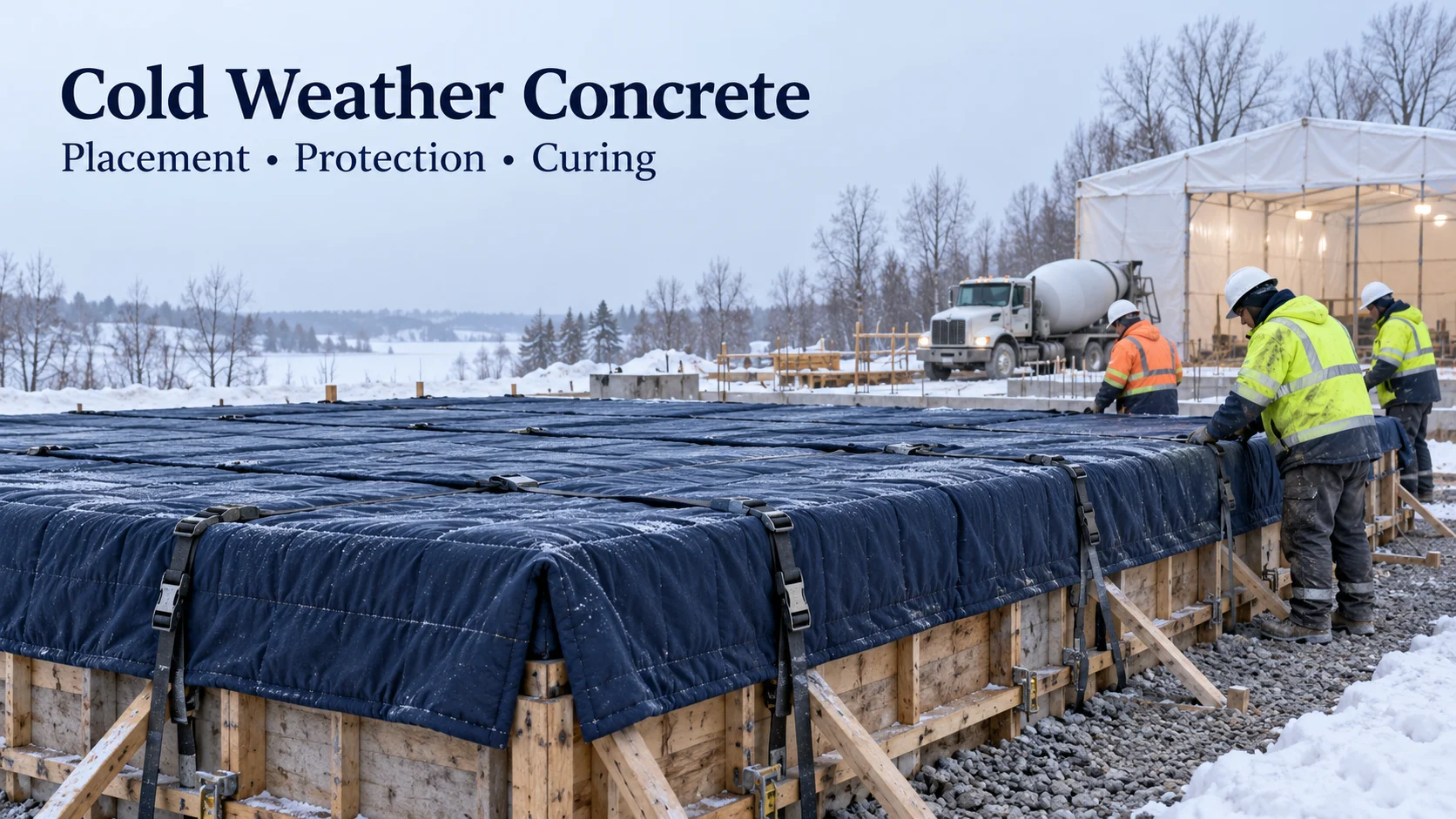
Cold weather concrete needs protection whenever air temperature falls, or is forecast to fall, below 40°F (4°C) during the protection period under ACI 306R-16. Select the concrete placement temperature by the member’s minimum dimension, then maintain heat and moisture until the specified strength and exposure conditions allow protection to end. The air-temperature trigger and the concrete-temperature target are separate checks. ACI 306R-16, §§1.1 and 3.1.
For reconstruction foundations, utility thrust blocks, bridge substructures and structural repair pours, that sequence belongs in the construction programme before concrete arrives. It connects site preparation to the installation and commissioning decisions in Ukraine’s infrastructure recovery. Use the temperature tables and winter pour checklist below to coordinate the producer, contractor, testing team and responsible engineer.
What temperature should concrete have at placement?
The smaller the minimum section dimension, the warmer the recommended concrete placement temperature. Thin members lose heat more readily, so a single temperature target for every pour misses a key design input.
| Minimum section dimension | Minimum concrete temperature as placed and maintained |
|---|---|
| Below 300 mm (below 12 in.) | 13°C / 55°F |
| 300–900 mm (12–36 in.) | 10°C / 50°F |
| 900–1800 mm (36–72 in.) | 7°C / 45°F |
| Above 1800 mm (above 72 in.) | 5°C / 40°F |
Source: GCP Applied Technologies, Cold Weather Concrete, TB-0106, 2016, Table 1, reproducing an ACI 306 table. NRMCA’s CIP 27 gives the same placement temperatures for the first three bands. The table retains the publications’ rounded metric/US pairs and band notation; identify the applicable band at a boundary in the project specification. Technical references.
These targets concern the concrete at placement and during protection. The producer may need a higher batching temperature to allow for transport and handling losses. A warm batch at the plant still needs a placement check, especially when travel or delays extend delivery. GCP’s bulletin also warns that mixing-water heating may become less effective in later batches.
When should the cold-weather plan start?
Start from the forecast through the protection period, including the nights after placement. ACI 306R-16 uses actual or expected air temperature below 40°F (4°C); waiting for a run of cold days can leave a fresh pour exposed to its first freezing night.
The three-day definition still found in older guidance is not the operative trigger in the 2016 guide. Name the edition in the winter plan so the contractor and testing team use the same criterion. Arrange protection before the pour, with a response for worsening weather and interrupted heat supply.
ACI 306R-16 is an engineering guide. For Ukrainian reconstruction work, its recommendations need to be applied through the project’s governing requirements, specifications and responsible engineer’s decisions. ACI itself directs specifiers to ACI 306.1 for requirements in specification format. ACI 306R-16, §1.1.
What must be ready before concrete arrives?
Prepare the receiving surfaces, delivery sequence and protection equipment together. Warm concrete can lose heat rapidly into cold contact surfaces, while snow and ice undermine the prepared placement area.
NRMCA’s CIP 27 recommends clearing snow and ice and bringing surfaces and embedded metal in contact with concrete above freezing before placement. Subgrade and forms may need advance insulation or heating. Confirm these conditions at the pour location, alongside the project’s requirements for the substrate and reinforcement.
Before releasing deliveries, coordinate:
- Concrete supply: the approved mixture, placement-temperature target, journey and expected placing sequence.
- Protection: blankets, insulated forms or enclosure, heating arrangements where needed, and enough coverage for edges and corners.
- Curing: the specified moisture-retention method, ready for use as finishing permits.
- Monitoring: concrete-temperature measurements at placement and agreed locations in the member during protection, including vulnerable edges and corners.
- Response: who acts if temperatures fall or heating stops, and what alternative protection is available.
These checks combine NRMCA’s preparation guidance with GCP’s pre-placement planning and temperature-record recommendations. Concrete temperature determines whether protection is working; the enclosure’s air temperature alone cannot establish that result.

When are blankets enough, and when is heating needed?
Use insulation to retain hydration heat; add enclosure and heating when the weather and member cannot sustain the required concrete temperature with insulation alone. Hydration—the reaction between cement and water—releases heat. The protection system must retain enough of that heat while preserving moisture for continued strength development.
ACI 306R-16 §§9.1–9.3 identifies weather, geometry and mixture proportions as relevant inputs. Lower air temperatures and stronger winds can require enclosure and heating. Longer protection also matters because hydration heat decreases as the concrete ages.
| Protection choice | When it is useful | Main control during the pour |
|---|---|---|
| Moisture-resistant insulating blankets or insulated forms | Retained hydration heat can maintain the required temperature | Keep coverage continuous and close-fitting; check concrete temperatures at exposed edges and corners |
| Enclosure with supplementary heat | Cold air or wind defeats insulation alone | Maintain concrete temperature, control drying and keep combustion exhaust outside |
| Moisture-retaining sheet or curing compound | The surface needs protection against evaporation | Use the specified curing method together with the thermal protection |
Select blanket thermal resistance from the planned weather exposure, member geometry, mixture, protection duration and supplementary heat. Member thickness alone is insufficient for selecting a blanket R value. Concrete-temperature records provide the feedback needed to adjust the system. Polyethylene sheeting helps retain moisture but has little insulating value compared with a thermal blanket. ACI 306R-16, §§9.1–9.3.
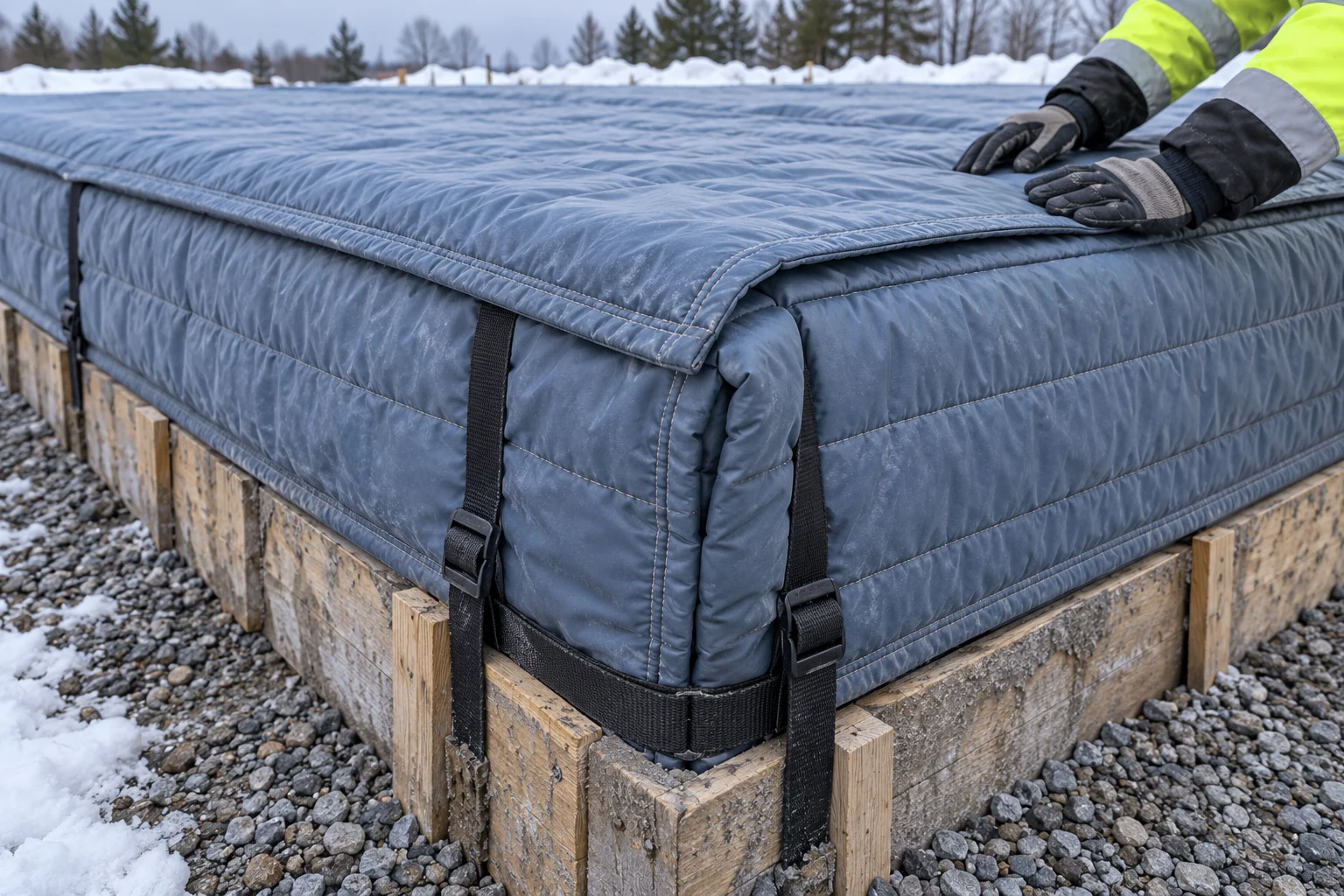
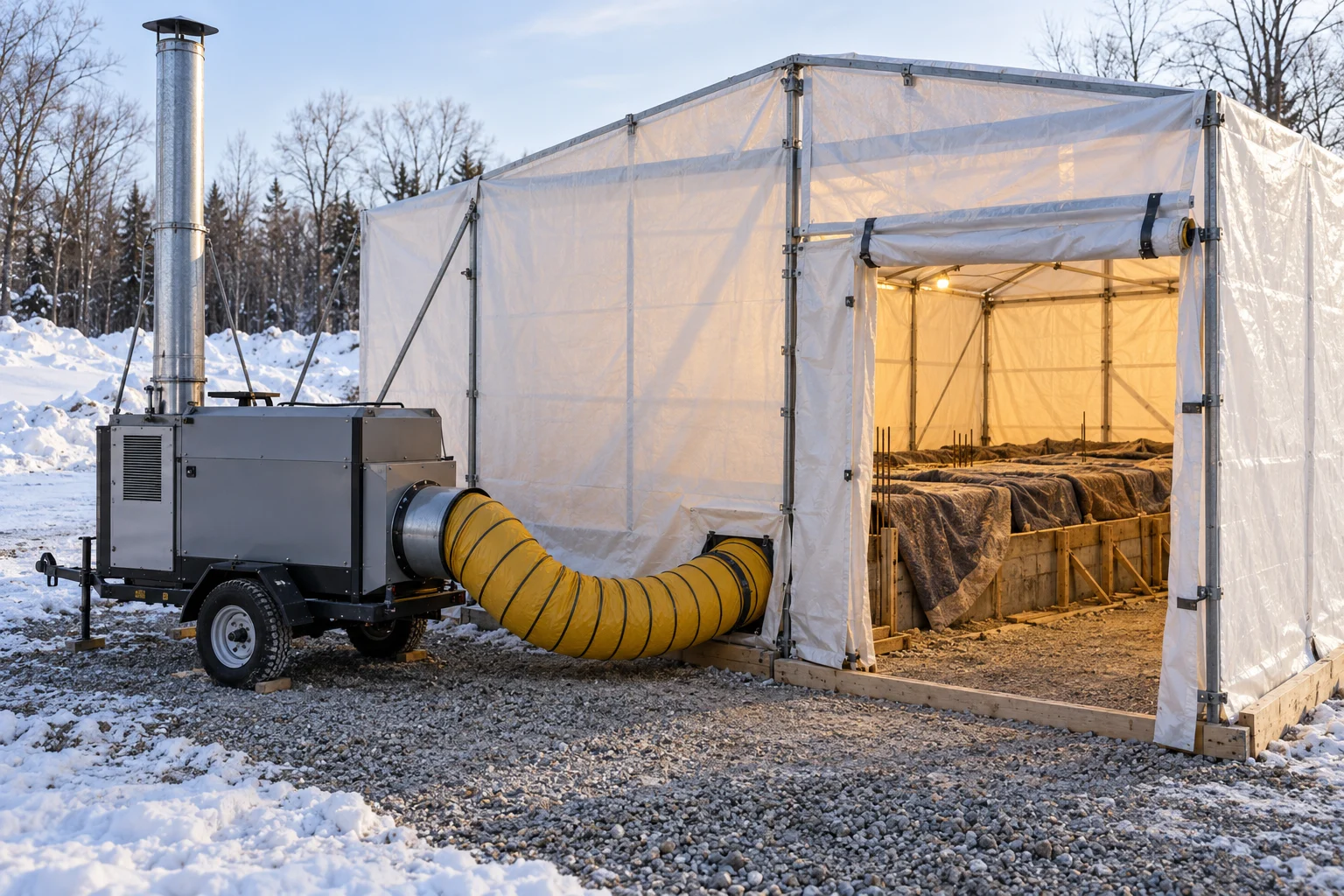
Heating introduces two additional controls. First, prevent surface drying: NRMCA recommends suitable membrane-forming curing compounds or impervious coverings and advises against water curing when freezing temperatures are imminent. Second, vent combustion heaters outdoors. Combustion exhaust can carbonate a fresh surface and cause dusting, as well as creating a ventilation hazard.
An indirect-fired arrangement can supply warm air to an enclosure while discharging combustion gases outside. Its capacity, ducting, clearances and operation must suit the enclosure and the equipment instructions. NRMCA CIP 27, p. 2; GCP TB-0106, p. 2.
What does the 3.5 MPa strength milestone establish?
About 3.5 MPa (500 psi) addresses early freezing resistance under specific moisture conditions. Structural loading and support removal require their own strength criteria. ACI 306R-16 §3.1(a) explains that, when external water is unavailable, hydration reduces saturation as the concrete gains strength. Around this milestone, saturation falls below the level associated with damage from a single freezing cycle.
Keep three decisions distinct:
| Decision | Relevant criterion | Practical consequence |
|---|---|---|
| Protection from early single freezing | Approximately 3.5 MPa / 500 psi under ACI’s stated moisture condition | Establish early strength and moisture exposure before accepting freezing exposure |
| Exposure to repeated wet freeze–thaw cycles | NRMCA recommends at least 24 MPa / 3500 psi before exposure to repeated cycles, with appropriate air entrainment for wet freeze–thaw service | Continue protection to meet the exposure requirements |
| Loading or removing load-bearing forms and shores | Required in-place strength set for the member and construction loads | Obtain the strength evidence and release decision specified for the work |
Elapsed time alone cannot make these decisions. Temperature history and the mixture affect strength development. ACI 306R-16 §§8.1–8.4 calls for suitable in-place testing or maturity methods. Maturity estimates strength from the concrete’s temperature history using a relationship established for the actual mixture, with appropriate verification.
The 2016 guide cautions against using field-cured cylinders to estimate the member’s strength in cold weather because matching the structure’s thermal conditions is difficult. Standard-cured acceptance specimens serve a separate purpose. A warm cylinder or a warm enclosure cannot substitute for the member’s own strength evidence.
How should protection end?
Reduce protection gradually after the relevant strength and exposure requirements are met. Sudden cooling of the surface while the interior remains warm can produce thermal stresses and cracking.
GCP’s ACI-derived table gives these maximum gradual temperature drops during the first 24 hours after protection ends:
| Minimum section dimension | Maximum gradual surface cooling in the first 24 hours |
|---|---|
| Below 300 mm (below 12 in.) | 28°C / 50°F |
| 300–900 mm (12–36 in.) | 22°C / 40°F |
| 900–1800 mm (36–72 in.) | 17°C / 30°F |
| Above 1800 mm (above 72 in.) | 11°C / 20°F |
Source: GCP Applied Technologies, Cold Weather Concrete, TB-0106, 2016, Table 1. These are temperature drops, not final concrete temperatures. Retain the project’s specified cooling controls and monitoring during the transition.
A cooling rate, a surface-to-core temperature difference and a concrete-to-air difference at form removal measure different things. NRMCA’s discussion of cracking at a surface-to-interior difference around 20°C (35°F) does not establish a universal 20°C-per-day cooling allowance. ACI 306R-16 §7.6 also treats the concrete-to-air difference at form removal in relation to the member and its restraint.
Winter pour checklist: what should the site record contain?
Agree on the protection and release criteria before placing concrete, then retain the measurements that show whether those criteria were met. Use this checklist at the pre-placement meeting and update it through curing.
| Stage | Record and check |
|---|---|
| Define the member | Element location, minimum dimension, geometry, exposed faces and construction loads |
| Set the requirements | Governing specification, placement/maintenance temperatures, strength criteria and cooling controls |
| Plan the weather response | Forecast through protection, wind exposure, heat supply and response to interruption |
| Prepare the pour | Surface condition, snow/ice clearance, approved mixture, delivery sequence and available protection |
| Measure placement | Concrete temperature, measurement time and delivery/pour location |
| Maintain curing | Blanket/enclosure condition, moisture protection, temperature records and any corrective action |
| Verify strength | Mixture-specific maturity correlation or suitable in-place test evidence, with required verification |
| End protection | Authorized release decision, gradual cooling measurements and continuing exposure controls |
This checklist brings together ACI’s protection and strength guidance with NRMCA and GCP’s site-preparation recommendations. For building repairs, place it alongside the structural assessment described in housing rehabilitation and energy retrofit. Concrete curing records belong with the repair’s construction and acceptance records.
Technical references
- American Concrete Institute, ACI 306R-16: Guide to Cold Weather Concreting (2016). §§1.1–2.2 for the trigger and scope; §3.1 for objectives and early freezing; §7.6 for form-removal temperature differences; §§8.1–8.4 for in-place strength; §§9.1–9.3 for protection and insulation.
- National Ready Mixed Concrete Association, CIP 27 — Cold Weather Concreting (1998, 2014). Page 1 for placement temperatures and freezing exposure; page 2 for preparation, curing and heater exhaust.
- GCP Applied Technologies, Cold Weather Concrete, technical bulletin TB-0106 (2016). Page 2, Table 1, reproduces ACI 306 placement/maintenance temperatures and first-day cooling limits; the same page addresses planning, temperature records and vented heating.