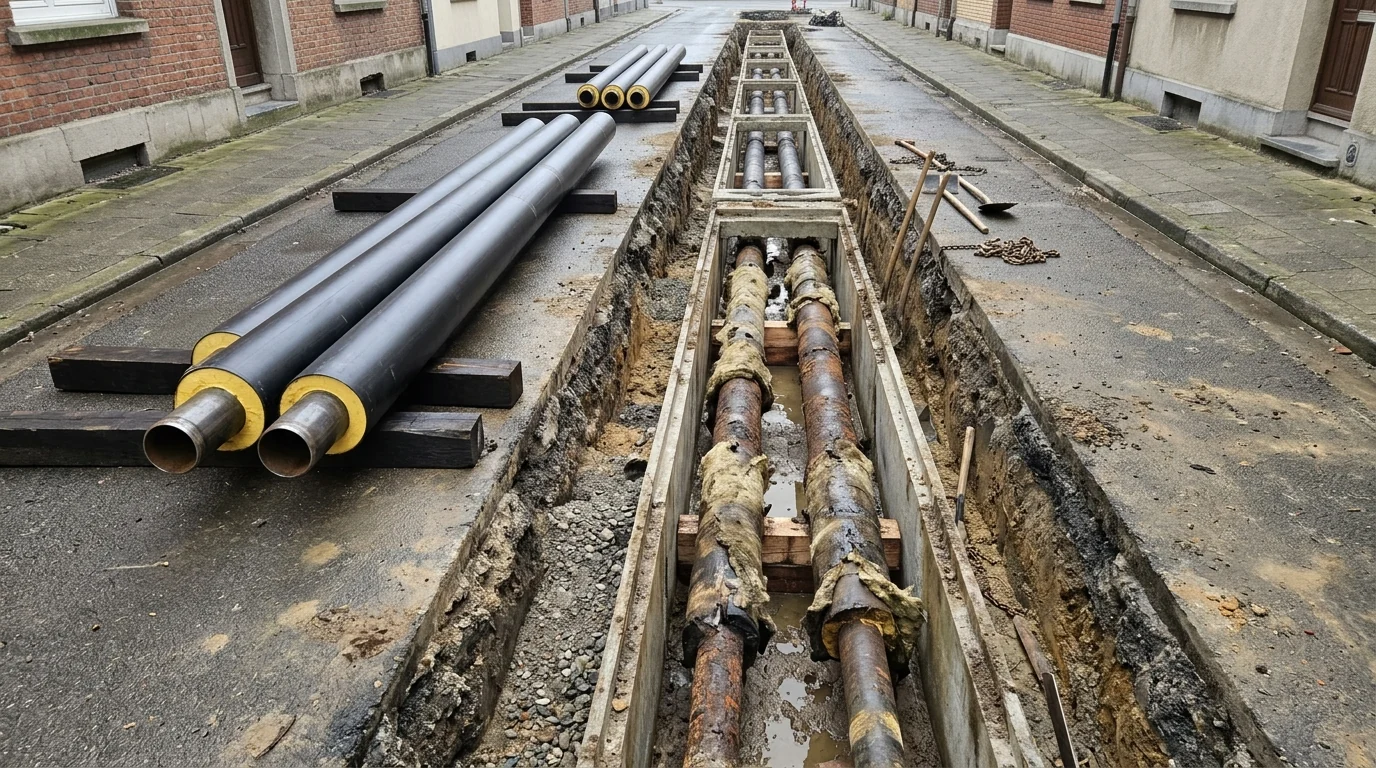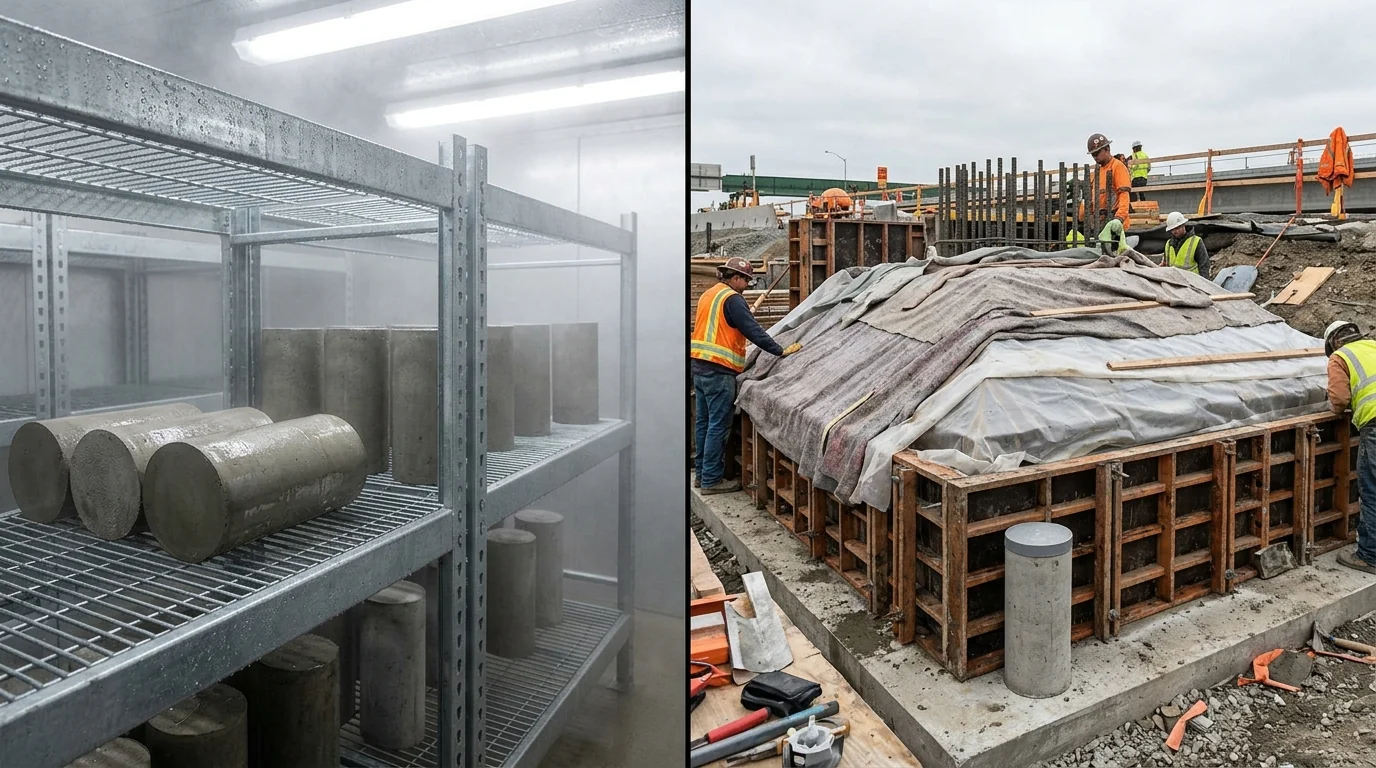
Standard-cured concrete test cylinders measure the compressive strength of concrete delivered to a project, verify mixture proportions, and support quality control, whereas field-cured companion specimens kept beside the structural pour estimate in-place strength before crews remove formwork or shoring or apply post-tensioning. Under ASTM C31/C31M, field specimens split by purpose into standard-cured and field-cured paths, and Specification C94/C94M requires compressive-strength specimens for acceptance to be standard-cured.
Across civil repair works covered in our Infrastructure and Energy section and broader Ukraine infrastructure recovery reporting, separating batch-acceptance records from in-place structural strength checks keeps engineers from misreading either test. A laboratory moist-room break evaluates the delivered mixture under controlled curing rather than clearing early winter stripping, while a cylinder baked dry or chilled on its opening day distorts the acceptance record before the truckload is judged.
| Verification path | Curing environment and reference method | Decisions supported on site |
|---|---|---|
| Standard-cured cylinders | Cast in the field under ASTM C31/C31M or AASHTO T23, then cured in a laboratory water tank or moist room until test age | Acceptance testing for specified concrete strength, checking mixture proportions, and quality control of concrete delivered to the project |
| Field-cured companion cylinders | Stored in as near as possibly the temperature and moisture conditions of the structural work | Estimating in-place concrete strength, comparing with standard-cured or in-place tests, judging curing and protection, form or shoring removal, and post-tensioning |
| Drilled cores | Extracted from hardened work and tested in compression under ASTM C39/C39M | Measuring the strength of the pavement in place |
| Concrete maturity method | In-place temperature history paired with a mixture-specific strength-maturity relationship and ASTM C 1074 verification tests | Tracking relative strength gain during construction when verified by early-age standard-cured specimen breaks or other permitted checks |
Which decisions use standard-cured cylinders versus field-cured companions?
Practice ASTM C31/C31M sets standardized requirements for making and curing cylinder and beam specimens from representative samples of fresh construction concrete, transporting them to the laboratory, and curing them in the laboratory. For standard-cured specimens, the practice lists acceptance testing for specified concrete strength, checking adequacy of mixture proportions for strength, and quality control. In FHWA-HIF-18-001, cylinders cast in the field and standard-cured under AASHTO T23 are transferred to a laboratory between 8 hours after final set and 48 hours, cured in water or a moist room at 73.5 ± 3.5 °F until test age (typically 28 days), and tested under AASHTO T22 to measure the strength of concrete delivered to the project. In that same Federal Highway Administration brief, a drilled core measures the strength of the pavement in place.
Field-cured specimens answer construction-stage questions about the placed member rather than batch acceptance. ASTM C31/C31M lists field-cured specimens for estimating in-place concrete strength, comparing results with standard-cured specimens or in-place test methods, judging the adequacy of curing and protection in the structure, timing form or shoring removal, and clearing post-tensioning. As the FHWA HMEC Module G fresh-concrete manual states, field-cured cylinders and beams should be cured in as near as possibly the temperature and moisture conditions of the structural work.
Compressive strength measured under ASTM C39/C39M is not a fundamental or intrinsic property of concrete made from given materials. Values obtained depend on specimen size and shape, batching, mixing procedures, sampling, molding, fabrication, and the age, temperature, and moisture conditions during curing. Because standard-cured cylinders are tested at 28 days, the New Jersey Department of Transportation maturity brief notes that conventional cylinder tests evaluate the quality of the concrete mixture used in the structure and cannot estimate strength at earlier ages for safe removal of formwork, shoring, post-tensioning, or opening to traffic. Placement temperatures, insulated blankets, and heated enclosures for sub-freezing pours belong to the site protection plan detailed in cold-weather concrete protection for reconstruction pours.
Both ASTM standards also state explicit material and technician boundaries. ASTM C31/C31M is not intended for concrete without measurable slump or specimens requiring other sizes or shapes, and it does not apply to lightweight insulating concrete or controlled low strength material (CLSM). ASTM C39/C39M covers molded cylinders and drilled cores prepared under C31/C31M for quality control of proportioning, mixing, and placing, specification compliance, and evaluating admixture effectiveness, limited to concrete with a density in excess of 800 kg/m 3 [50 lb/ft 3]. An individual who tests concrete cylinders for acceptance testing under C39/C39M shall meet the concrete laboratory technician requirements of Practice C1077, including an examination with a performance demonstration evaluated by an independent examiner.
Why do first-day curing and transport decide cylinder break results?
Moisture loss, temperature swings, or physical jarring during the opening hours after casting alter a cylinder before laboratory moist curing begins. In the FHWA-HRT-05-057 Appendix B initial-curing revisions, molded specimens shall be stored in a moist environment preventing any loss of moisture for up to 48 hours at 16 to 27 °C (60 to 80 °F). For concrete mixtures with a specified strength of 40 MPa (6,000 psi) or greater, that initial curing temperature narrows to 20 to 26 °C (68 to 78 °F). FHWA HMEC Module G states the same 16 to 27 °C [60 to 80 °F] moist storage window up to 48 hours after molding.
State transportation manuals can set their own initial field storage rules, which engineers should keep distinct from the ASTM and AASHTO 16 to 27 °C initial-curing band. Under Delaware DOT’s field specimen manual, all test specimens during the first 24 to 48 hours after molding shall be stored under conditions representative of the concrete in the structure or pavement. After that initial period, Delaware laboratory curing consists of a minimum of 95% humidity and a temperature of 73.4 ± 3 °F (23 ± 0.94 °C). By comparison, a laboratory study published in Materials (PMC7085069) stored demolded specimens until the day of test at T = 20 ± 2 °C and RH = 100 ± 5%, meeting the requirements of EN 12390-2.
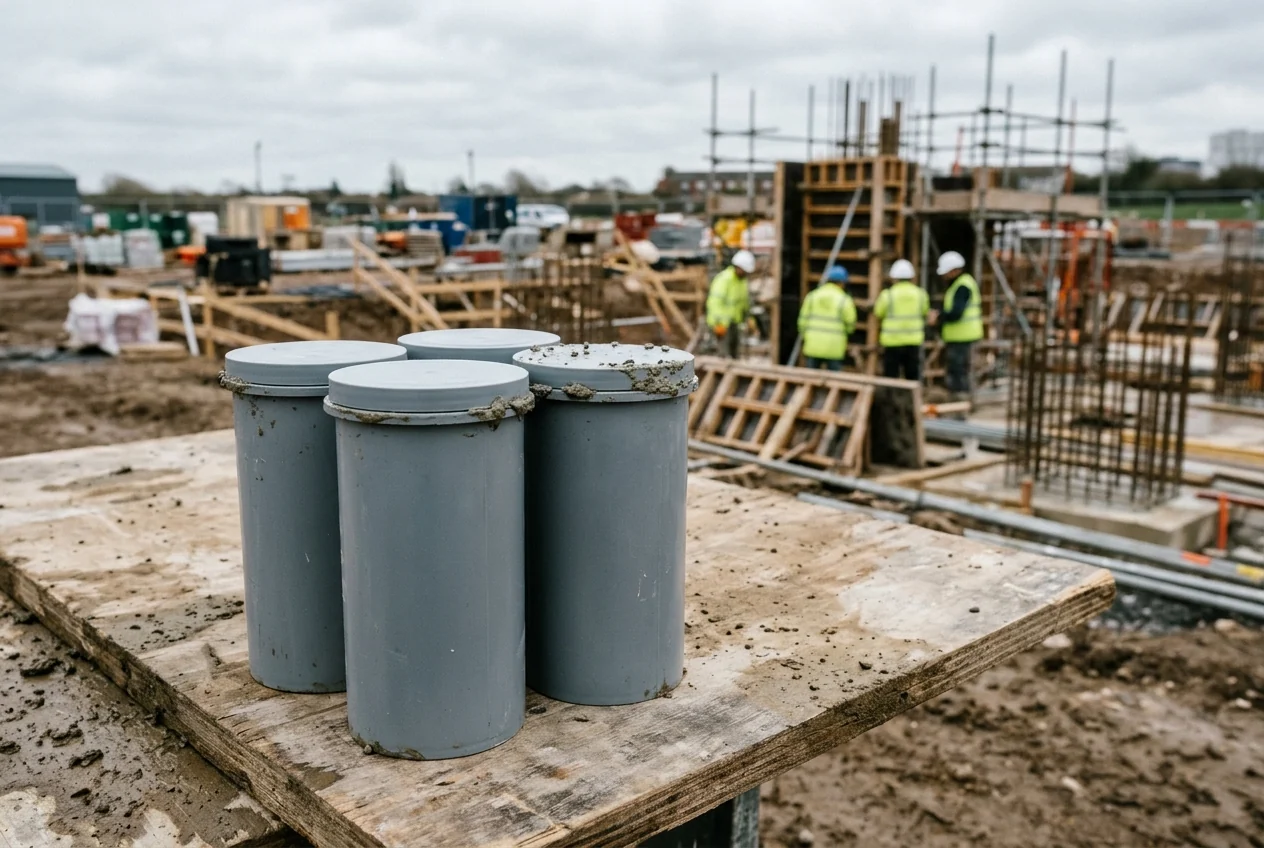
Field preparation and transport procedures across state inspection manuals target evaporation, vibration, and handling shock:
- NYSDOT’s concrete field inspection manual places cylinder molds on a level, smooth, rigid surface free of vibrations and other disturbances, and marks each cylinder with an indelible marking pen or other suitable means unaffected by water or moisture.
- Delaware DOT forms molds on a level, rigid, horizontal surface free from vibration as near as practicable to the 24-hour storage spot, covers specimens immediately after finishing to prevent water evaporation from unhardened concrete, and warns technicians not to jar, strike, tilt, or scar specimen surfaces when moving them.
- When specimens ship from the field to the laboratory under Delaware DOT rules, crews load, transport, and unload them carefully to minimize handling effects, and laboratory staff place them immediately into the required curing facility upon receipt.
- Prior to compression testing under Louisiana DOTD’s cylinder testing procedure, cylinders may remain outside the moist room for up to 3 hours if covered with a moist absorbent fabric in an environment between 68 and 86 °F.
How are cylinders loaded, and what do 7-day and 28-day breaks decide?
Seven-day breaks serve as an early trend check, whereas 28-day breaks govern standard design and specification acceptance unless contract documents set another age. As Wikipedia’s overview of compressive strength summarizes, interim field compression tests at 7 days verify the compressive strength anticipated at 28 days so site teams are forewarned of a failure and can take precautions; the same reference defines characteristic strength as the strength below which not more than 5% of test results are expected to fall. In Louisiana Transportation Research Center’s study on accepting concrete other than 28 days, researchers note that a conventional ordinary portland cement (OPC) mixture generally develops the majority of its compressive strength 28 days after placement, citing ACI 318-19 section 19.2.1.3 (design strength based on 28-day test results) and ASTM C94 sections 6.4.1.1 and 6.6.1.1 (specified test age of 28 days for strength requirements unless otherwise specified). Separately, FHWA-HIF-18-001 observes that US concrete paving specifications typically require compressive strengths between 3000 and 4000 psi at 28 days, a US highway paving benchmark rather than a structural reconstruction design value.
Specimen counts and break-age tolerances follow the governing agency specification. Unless project specifications require otherwise, Delaware DOT defines a standard testing set as 4 cylinders (two 7-day breaks and two 28-day breaks) accompanied by 1 slump test. Louisiana DOTD sets permissible break-age tolerances at ± 6 hours for 7-day breaks and from -20 hours to +3 days for 28-day breaks. When calibrating curves in the Oregon DOT maturity demonstration, technicians ran ASTM C 39 compression tests at 1, 3, 7, 14, and 28 days and tested a third cylinder, averaging all three specimens, whenever the range of test results exceeded 10 percent of the average.
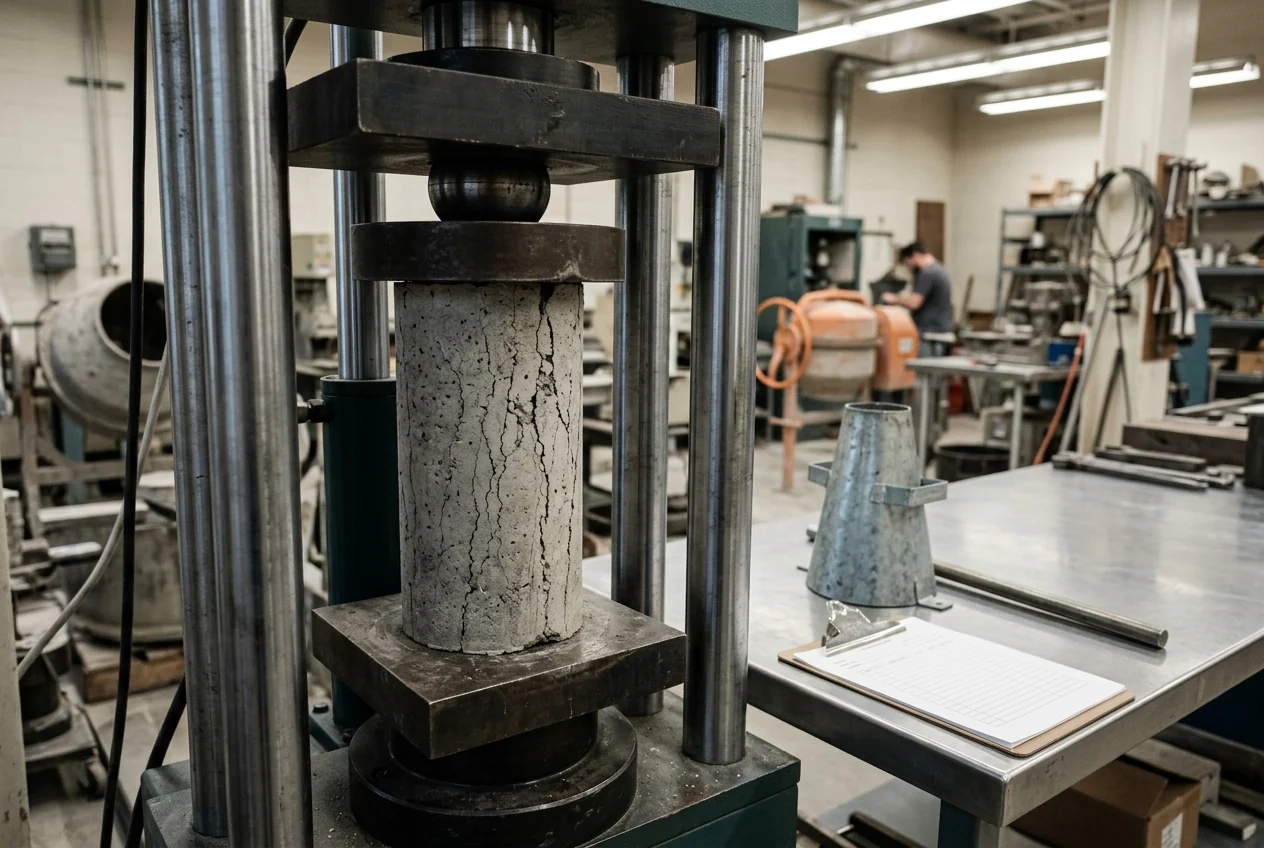
Compression platen loading rates are specified per testing code and stay separate across American and European standards. Under the Louisiana DOTD procedure, the testing machine applies load continuously and without shock at a rate of movement corresponding to a stress rate on the specimen of 35 ± 7 psi/s; a higher loading rate is permitted during the first half of the anticipated loading phase, while the designed rate of movement shall be maintained at least during the latter half. Under European standard EN 12390-3, as reported in Materials (PMC7602431), specimens were loaded at a constant loading rate of 0.6 MPa/s to failure.
How does the concrete maturity method pair with verification breaks?
The concrete maturity method estimates in-place concrete strength from a mixture-specific strength relationship. As NIST’s review of the maturity method recounts, a cooling-tower construction failure on April 27, 1978 in Willow Island, West Virginia caused the death of 51 workers. At the time of collapse, the previous concrete lift in the shell was 1 day old after exposure to an estimated average ambient temperature less than 10 °C, and investigators concluded that the most likely cause was insufficient concrete strength to support the applied construction loads. That US failure convinced National Bureau of Standards researchers of an urgent need for standards to estimate in-place concrete strength during construction.
As NJDOT’s protocol brief states, samples of the same concrete have equal strength if they reach equal maturity, irrespective of their actual time-temperature histories. Because structural members and small molds differ in mass and heat development, NJDOT notes that concrete in a test cylinder may take 28 days to reach the same maturity level that concrete in the structure reaches in 7 days.
Applying ASTM C 1074 on site requires the steps described by NIST, alongside physical verification breaks:
- Determine the appropriate maturity function for the specific concrete mixture used in construction, where NIST notes recommended calculation constants of a 0 °C datum temperature for the Nurse-Saul function (when ASTM Type I cement is used without admixtures within an expected curing range of 0 °C to 40 °C) and an activation energy of 41.5 kJ/mol for the Arrhenius equation.
- Establish the compressive strength versus maturity index relationship in advance, then measure the in-place maturity index to estimate in-place strength.
- Verify potential strength before critical operations such as formwork removal or post-tensioning. Because temperature history is the only measurement made in the field, NIST emphasizes that maturity can provide information only on relative strength gain and offers no assurance that the placed batch had the correct mixture proportions; one verification option named in ASTM C 1074 is early-age compressive strength tests of standard-cured specimens molded from samples of the concrete in the structure.
How do aggregate size and testing codes set cylinder and cube dimensions?
Mold geometry follows both coarse aggregate grading and whether a contract invokes American cylinder standards or European cube rules. Under Delaware DOT specifications, compression test specimens are cylindrical with a length equal to twice the diameter. Standard cylinders measure 6 inches (15 cm) in diameter by 12 inches (30.5 cm) in length when coarse aggregate does not exceed 2 inches (50 mm) nominal size. Smaller cylindrical specimens keep a ratio of specimen diameter to maximum aggregate size no less than 3 to 1, and concrete containing aggregate larger than 2 inches (50 mm) requires a cylinder diameter at least 3 times the maximum nominal aggregate size. Where demolition-derived coarse fractions enter concrete production, screening and constituent limits follow the boundaries examined in recycled concrete aggregate from building rubble.
European specifications pair cylinder values with 150 mm cube testing at 28 days. Both Wikipedia’s compressive strength article and Materials (PMC7602431) state that characteristic compressive strength is specified at 28 days on 150 mm concrete cubes. For C30/37 concrete grade, PMC7602431 reports a minimum characteristic cylindrical strength of 30 MPa and a minimum characteristic cubical strength of 37 MPa. In Materials (PMC7085069), the ratio of cylinder strength to cube strength for normal-weight concrete (abbreviated NWAC in that paper) ranges from 0.78 up to 0.87 and increases for higher strength classes.
How do slump tests and batch tickets identify the sampled load?
A hardened break result has engineering meaning only when fresh-concrete tests and a concrete batch ticket tie the cylinders to a specific truckload, structural element, and water addition record. As Wikipedia’s concrete slump test reference explains, the slump test measures fresh concrete consistency before set, checks workability and flow ease, and can indicate an improperly mixed batch. American standards specify a slump cone with a height of 12 inches (300 mm), a bottom diameter of 8 inches (200 mm), and an upper diameter of 4 inches (100 mm). Under European standard EN 12350-2:2019 as summarized on that page, the slump test is sensitive to consistence changes for slumps between 0.4 and 8 inches (10 and 210 mm), can be unsuitable beyond those extremes, is not suitable if slump continues to change for 1 minute after cone withdrawal, and is not suitable when maximum aggregate size exceeds 1.6 inches (40 mm).
Across federal and state inspection manuals, fresh measurements and delivery documentation travel with every structural cylinder set:
| Agency manual or form | Fresh tests and load verification entries | Specimen chain-of-custody record |
|---|---|---|
| FHWA HMEC Module G | Slump (T 119 / C143), air content (T 196 / C173 or T 152 / C231), and concrete temperature (C1064) | Identification number, location of concrete represented, date, time, molder names, fresh test results, curing method, and any deviations from standard test methods |
| NYSDOT field inspection manual | Slump test, air content test, and concrete and air temperatures required with structural compressive cylinders as the Cylinder Series | Each cylinder marked with an indelible marking pen or means unaffected by water or moisture |
| Georgia DOT documentation | DOT 525 (or attached computerized batch ticket) with each load; inspector checks specified concrete class and records slump if tested, cubic yards, air content if tested, water added at jobsite, air and concrete temperatures, mixing-speed revolutions, and cylinder sample number | DOT 319 accompanies test specimens to the branch or designated laboratory for testing |
| Rhode Island DOT ticket WP6-325 | Slump, concrete and ambient temperatures, and 4-inch or 6-inch cylinder diameter | Final curing checked as moist room, field cured, or on site, plus break schedule in days including 7 and 28 |