Retainage in construction is a portion of the agreed contract price withheld from periodic progress payments until work is complete to incentivize performance and protect the owner against defects, liens, or default. Public fixed-price rules cap performance-triggered holdbacks at 10 percent, while private and international contracts commonly withhold 5 to 10 percent until completion milestones.
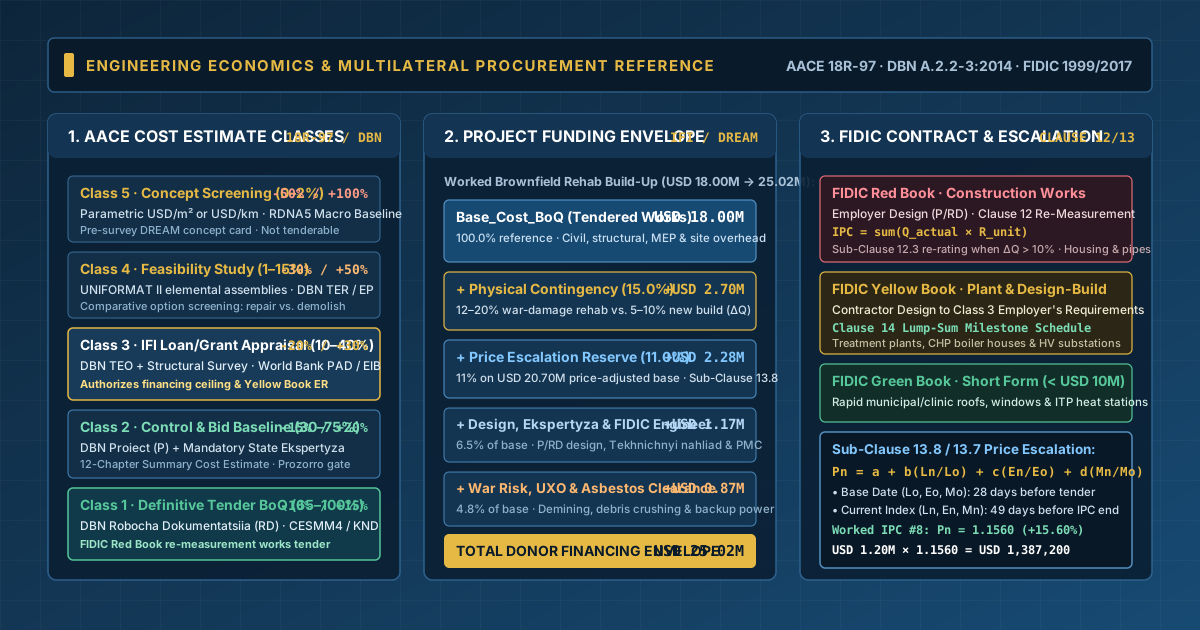
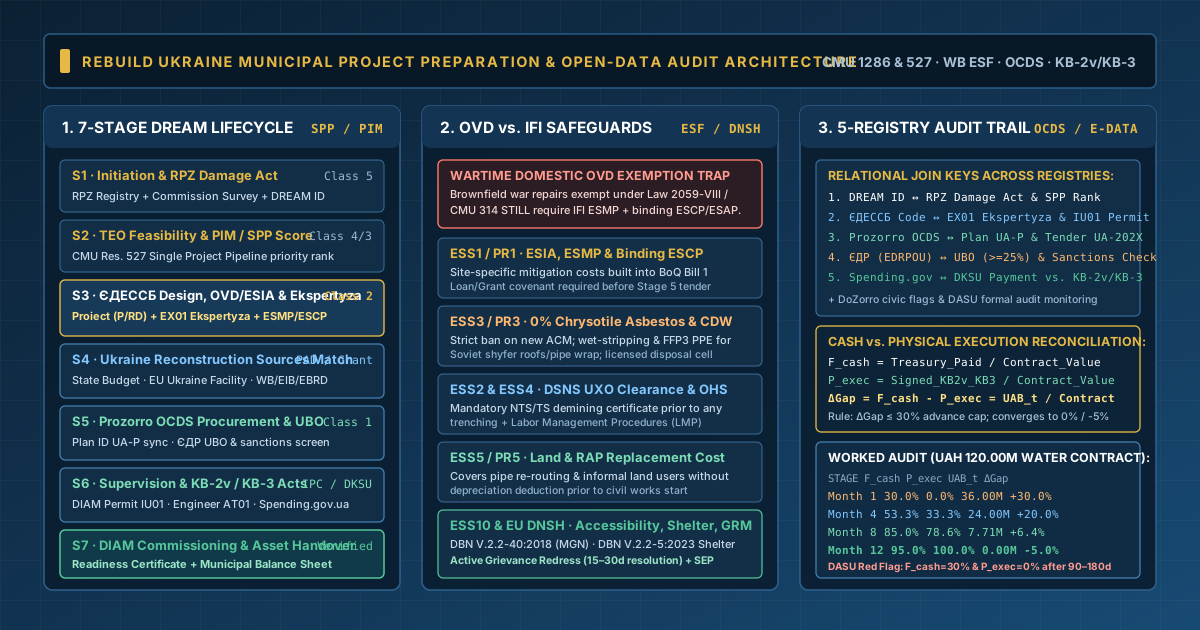
Across public recovery programmes followed on our home page and in our Ukraine reconstruction funding guide, separating approved contract budgets from disbursed cash and accepted physical work keeps readers from misinterpreting payment records. Pre-tender cost reserves and escalation formulas sit in construction cost estimation for donor-funded projects, while multi-registry payment verification sits in Rebuild Ukraine project preparation and transparency; once civil works start, progress-payment holdbacks and release gates govern how much verified monthly value reaches prime contractors and local trades.
How does a 10% withholding cap work when progress lags?
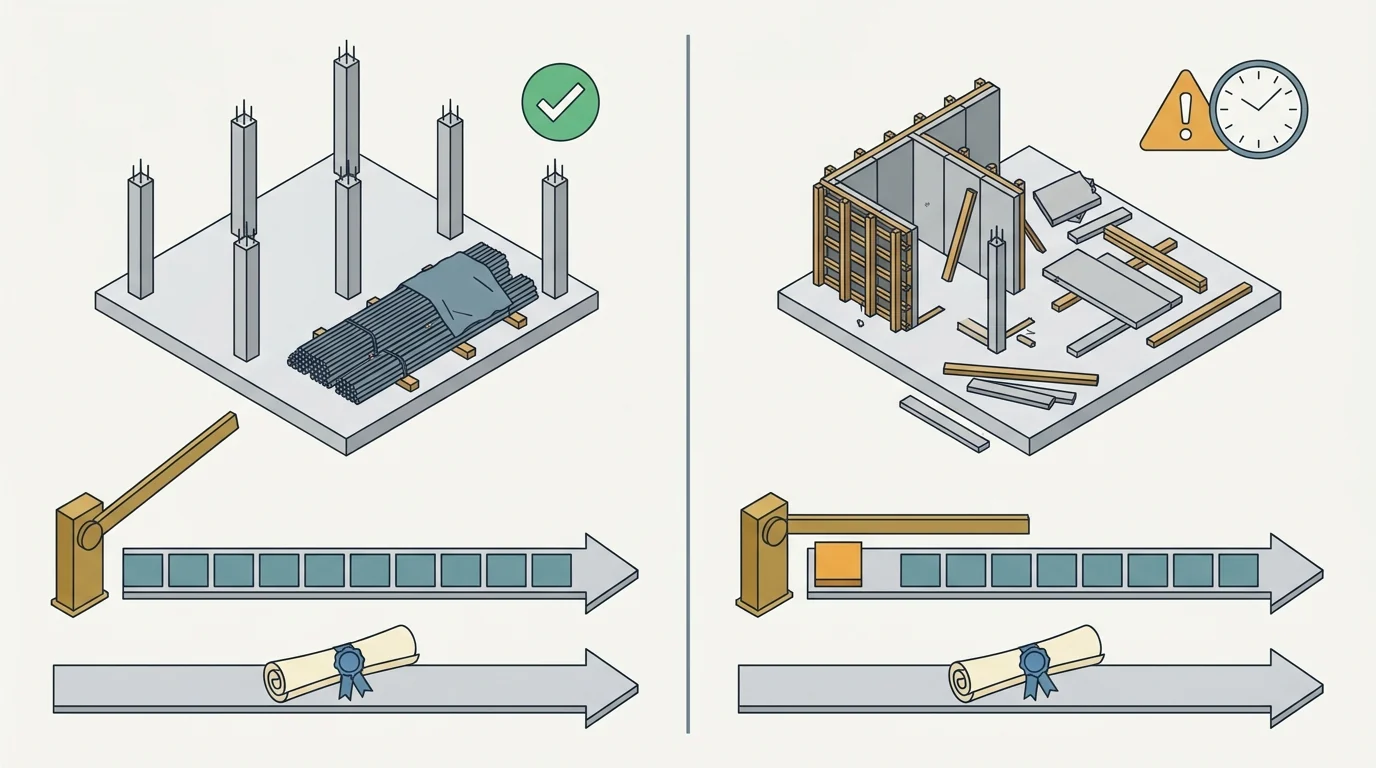
Under FAR 32.103 and FAR 52.232-5, contracting officers authorize monthly progress payments in full whenever performance is satisfactory and may withhold up to 10 percent of the approved estimate on a case-by-case basis only when progress lags, whereas private US contracts routinely start at 10 percent.
Federal procurement policy in section 32.103 states that retainage should not serve as a substitute for active contract management and that contracting officers should not withhold funds without cause. When a contractor fails to achieve satisfactory progress during a billing period, the contracting officer determines both whether to retain funds and the exact withholding percentage on a case-by-case basis after evaluating past performance and the likelihood that such performance will continue. Under both section 32.103 and clause 52.232-5 (Payments under Fixed-Price Construction Contracts, May 2014), any withheld retainage cannot exceed 10 percent of the approved estimated payment amount until satisfactory progress resumes.
Two federal fixed-price boundaries sit alongside that 10 percent cap. First, under clause 52.232-5, once the contractor requests reimbursement and furnishes proof of full payment to the surety, the Government reimburses performance and payment bond premiums (including coinsurance and reinsurance agreements), and retainage rules do not apply to the bond-premium share of the progress payment. Second, notwithstanding other contract terms, progress payments cannot exceed 80 percent on work accomplished under undefinitized contract actions as defined in FAR subpart 2.1.
In negotiated United States private and state-regulated construction agreements summarized in Wikipedia’s overview of retainage, 10 percent is the withholding rate most frequently adopted, subject to state statutory caps. Contracting parties often modify a flat 10 percent deduction by stepping the rate down to 5 percent once the project is 50 percent complete, or by carving material costs out of withholding because material suppliers frequently reject retainage terms in purchase orders.
| Contract condition or payment line | Governing clause or market practice | Withholding ceiling or payout limit (% of approved amount) | Trigger and adjustment rule |
|---|---|---|---|
| Satisfactory monthly progress (US federal fixed-price) | FAR 32.103 and FAR 52.232-5(e) | Full approved payment authorized (no percentage withheld) | Contracting officer verifies quality-compliant progress and does not withhold funds without cause |
| Unsatisfactory monthly progress (US federal fixed-price) | FAR 32.103 and FAR 52.232-5(e) | Maximum of 10% retained | Determined case by case from past performance and likelihood of continuation until satisfactory progress is achieved |
| Performance and payment bond premiums | FAR 52.232-5(g) | Exempt from retainage (paid in full upon proof) | Reimbursed after contractor furnishes evidence of full premium payment to the surety |
| Undefinitized contract actions | FAR 52.232-5(i) and FAR subpart 2.1 | Progress payments capped at 80% of accomplished work | Applies across undefinitized actions regardless of other contract provisions |
| Typical US private or state-regulated contract | US commercial practice (subject to state statutes) | Commonly 10% initial rate, or 10% stepping down to 5% at 50% completion | Set in contract; parties may also carve out supplier material purchase orders from withholding |
Which milestones govern partial and final retainage release?
Fixed-price public construction clauses release withheld funds across three milestones: percentage-free payment upon completion and acceptance of separately priced buildings or contract divisions, partial release at substantial completion holding back only adequate protection for remaining work, and prompt final payment after full acceptance, voucher presentation, and a release of claims.
Separate building acceptance and substantial completion step-downs
On multi-structure civic or infrastructure sites, FAR 52.232-5 prevents completed facilities from being held hostage to unfinished phases elsewhere on the contract. Upon completion and acceptance of each separate building, public work, or other contract division whose price is stated separately in the agreement, payment is made in full for that completed division without retaining a percentage. As overall contract completion nears, FAR 32.103 also permits contracting officers to adjust previously withheld retainage to reflect better-than-expected performance or reliance on alternative safeguards.
When the overall construction work reaches substantial completion, clause 52.232-5 allows the contracting officer to retain from previously withheld sums and future progress payments only the amount considered adequate to protect the Government, requiring release of all remaining withheld funds to the contractor. In commercial construction practice, disputes regularly center on whether contract language ties release to substantial completion—generally defined as the point when the owner can occupy a structure and use it for its intended purpose—or holds funds back until an entire punch list of minor closeout items is finished.

Final acceptance, closeout vouchers, and defects-liability moieties
Under FAR 32.103, retained amounts shall be paid promptly once all contract requirements are completed. Clause 52.232-5 specifies three administrative prerequisites before final payment is disbursed: completion and acceptance of all contract work, presentation of a properly executed payment voucher, and presentation of a release of all claims against the Government arising under the contract other than specifically excepted claims in stated amounts (with an assignee release also permitted where payment rights were assigned under the Assignment of Claims Act of 1940). By contrast, UK and international contracts that hold retention security typically split release into two moieties, paying half at project completion and holding the second half until the defects liability period—often 12 months—expires.
| Release stage | Governing rule or practice | Portion released vs retained | Required verification gate |
|---|---|---|---|
| Separately priced building or division acceptance | FAR 52.232-5(e) | Paid without retention of a percentage | Completion and formal acceptance of the separately priced building, public work, or division |
| Pre-closeout performance adjustment | FAR 32.103 | Discretionary reduction below the 10% cap | Better-than-expected contractor performance or availability of alternative safeguards |
| Substantial completion | FAR 52.232-5(e) and US commercial practice | All excess withheld funds released; only adequate protection retained | Work reaches substantial completion (structure ready for intended occupancy and use), leaving punch-list protection |
| International completion and defects period | UK and international retention practice | 5% retention released in two equal moieties (half and half) | First moiety at project completion; second moiety after the defects liability period (often 12 months) |
| Final contract closeout | FAR 32.103 and FAR 52.232-5(h) | Full remaining balance paid promptly | Completion and acceptance of all work, properly executed voucher, and release of claims (save stated exceptions) |
How does US retainage compare with international retention money?
United States contracts use the term retainage—authorizing payment in full when federal work stays on track or withholding 10 percent in private agreements that often step down to 5 percent at 50 percent completion—whereas UK and international contracts typically deduct 5 percent retention split into two moieties across a 12-month defects liability period.
As documented in Wikipedia’s history of retainage and retention, withholding originated during the 1840s construction of the United Kingdom railway system during Railway Mania. Rapid railway expansion drew inexperienced, unqualified contractors into the labor market, prompting railway companies to withhold as much as 20 percent of contractor payments to offset completion costs upon default; the original intent was to hold back only contractor profit rather than force contractors and subcontractors to finance the works.
Modern contract families treat cash holdbacks very differently across jurisdictions:
- UK Joint Contracts Tribunal (JCT): Reformed retention handling by permitting clients to hold retention monies in trust; the 1998 JCT revision allowed contractors to request a separate bank account and permitted retention bonds, while the 2016 JCT contract enables retention-free projects.
- NEC Engineering and Construction Contract: Introduced in 1993 without retentions in its core clauses, relying instead on collaborative defect reduction unless clients add optional variant clauses; its 2017 fourth edition incorporates retention bonds and permits withholding solely on the labour portion of prices, only on final payments, or replacing retention with project bank accounts.
- Commonwealth statutory holdbacks: Known in Canada as holdback payments, where all retention monies have been required to sit in ring-fenced accounts since 1997; New South Wales mandates ring-fenced accounts at authorized banks on large projects, and New Zealand enacted mandatory trust-held cash or liquid-asset retention rules following the 2013 collapse of main contractor Mainzeal.
Why is retainage tracked separately in construction accounting?
Under construction project accounting governed in the United States by AICPA Statement of Position SOP 81-1, contractors recognize Percentage of Completion revenue from actual cost versus total estimated cost independently of cash draws, while stage-payment retentions remain conditional upon completion, unsuitable for accounts-receivable factoring, and excluded from prime billings under FAR 52.232-5.
Project accounting tracks revenues and costs per contract using progress billings and draws, charging direct costs (labor, materials, subcontracting, and land) plus indirect field costs (supervision, tools, equipment, supplies, insurance, and support) to each job while generally excluding selling, general, and administrative expenses. Under SOP 81-1, most contracts recognize revenue under the Percentage of Completion Method by multiplying the contract price by the estimated percent complete—for example, dividing actual cost to date by total estimated cost to establish a 29 percent completion ratio in year one and recognizing 29 percent of the contract price—whereas the Completed Contract Method defers revenues and costs until substantial completion when reasonable estimates cannot be determined.
Because withheld retainage is payable only once contractual completion milestones are satisfied rather than on standard net-day invoice terms, accounting and treasury teams separate conditional retainage balances from collectible progress receivables for three reasons:
- Prime billing exclusion for subcontractor holdbacks: Under FAR 52.232-5, every prime contractor progress billing certification must confirm under Chapter 39 of Title 31, United States Code that prior subcontractor and supplier payments due have been made, timely payments will follow from current proceeds, and the request excludes any amounts the prime contractor intends to withhold or retain from a subcontractor or supplier under its subcontract.
- Accounts-receivable factoring limits: Because retentions operate as conditional stage payments, their presence can render construction companies unsuitable for factoring (selling accounts receivable for working capital).
- Insolvency exposure in commingled accounts: Where retention monies sit un-ring-fenced inside a client’s or main contractor’s general bank account rather than a separate trust, liquidation puts supply-chain funds at severe risk—demonstrated during the 2018 collapse of UK contractor Carillion, when £250 million in unpaid retention owed to subcontractors was lost.
How do monthly progress certificates calculate net cash disbursed?
Monthly progress certificates under FAR 52.232-5 sum quality-compliant work accomplished, authorized on-site or title-verified off-site stored materials, and retainage-exempt surety bond premiums, verify subcontractor payment schedules and exclusions, deduct up to 10 percent only if progress lags, and charge 91-day Treasury-bill interest on non-conforming unearned amounts from the 8th day after receipt.
Under clause 52.232-5, the Government pays monthly as work proceeds—or at more frequent intervals set by the contracting officer—based on approved estimates of work meeting contract quality standards. All material and work covered by progress payments become the sole property of the Government upon payment, without relieving the contractor from sole responsibility for paid material and work, restoring damaged work, or fulfilling all contract terms.
| Monthly certificate step | Governing FAR 52.232-5 provision | Required substantiation or calculation rule | Retainage and interest treatment |
|---|---|---|---|
| Work accomplished in period | Paragraph (b) and (b)(1)(i) | Itemization of requested amounts tied to contract work elements meeting quality standards | Paid in full if progress is satisfactory; up to 10% withheld if progress lags |
| Stored materials and preparatory work | Paragraph (b)(2)(i)–(ii) | Contracting officer may include on-site delivered material and preparatory work; off-site material requires explicit contract authorization plus proof of acquired title and dedicated contract use | Subject to same progress evaluation; title transfers to Government upon payment under paragraph (f) |
| Subcontractor schedule and certification | Paragraph (b)(1)(ii)–(iv) and (c)(1)–(4) | Lists current subcontractor work, total subcontract amounts, and prior subcontractor payments; certifies compliance with Chapter 39 of Title 31, United States Code | Must exclude any amounts the prime contractor intends to withhold or retain from subcontractors; not final acceptance |
| Performance and payment bond premiums | Paragraph (g) | Contractor request backed by evidence of full premium payment to the surety (including coinsurance and reinsurance) | Exempt from retainage provisions under paragraph (e) |
| Post-certification unearned amount adjustment | Paragraph (d) and (j) under 31 U.S.C. 3903(c)(1) | Contractor notifies contracting officer upon discovering certified non-conforming work (unearned amount) | Interest runs from the 8th day after receipt at average bond equivalent rates of 91-day Treasury bills from the most recent prior auction, deducted from the next payment |
How can contracts prevent subcontractor cash-flow distress?
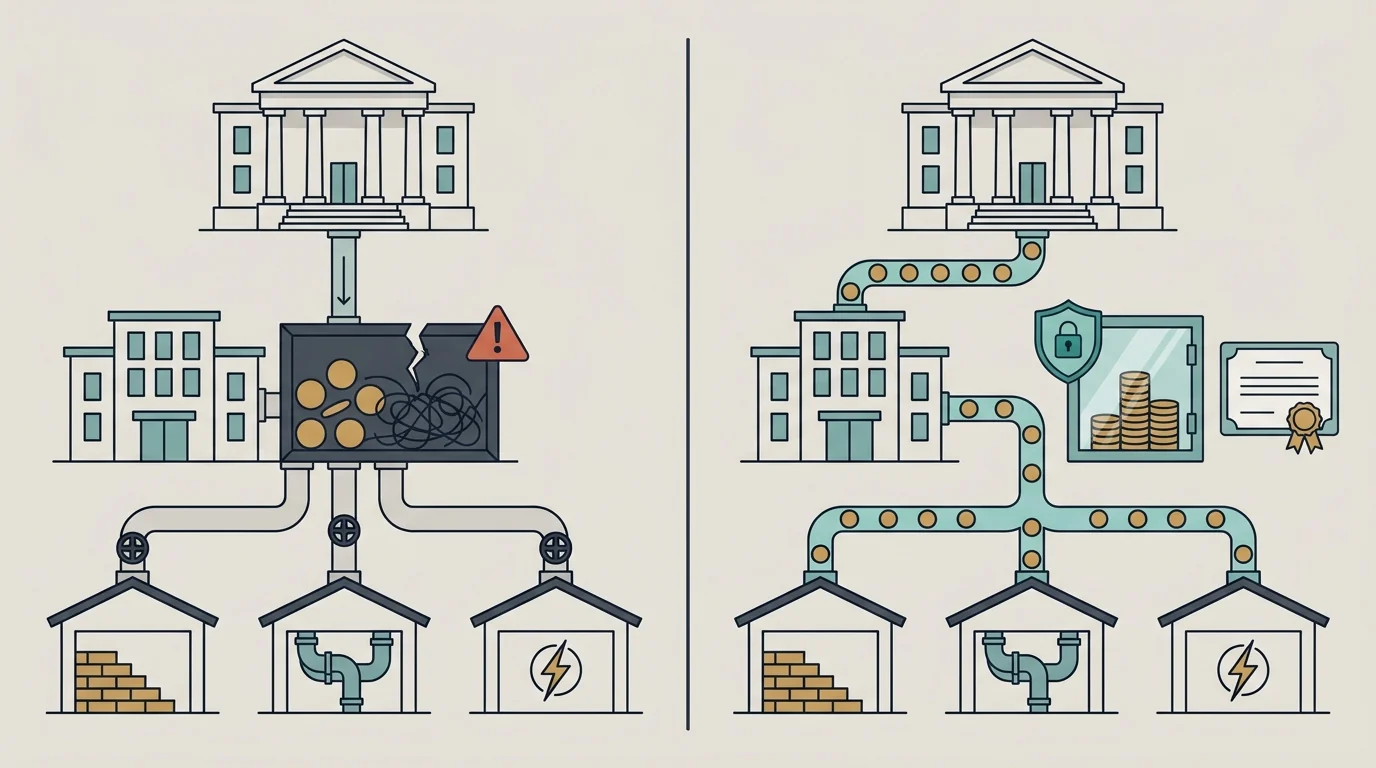
Public and reconstruction employers prevent supply-chain cash shortfalls and bid-price padding by banning cross-contract retention linkage, carving out supplier material costs, stepping down holdbacks as milestones pass, and substituting surety retention bonds, bank letters of credit, or ring-fenced fiduciary trust accounts for unsegregated cash retentions held in general bank accounts.
Why cascading holdbacks inflate reconstruction bids and stall closeout
Although retainage is meant to incentivize completion and guard against late-stage liens or defaults, owners and prime contractors frequently use withheld funds as informal project financing, and prime contractors often withhold a higher percentage from subcontractors than the owner withholds from the prime. Early-trade specialists—such as site-work crews finishing excavation in the opening months—often wait years to recover withheld sums tied to whole-project substantial completion. A 2017 British government report found that more than half of contractors experienced late or non-payment of retentions, with longer delays hitting subcontractors, restricting working cash flow and capital investment, and prompting smaller firms to write off retentions and raise bid prices to compensate.
Over-withholding also distorts closeout incentives. When a prime contractor withholds a larger percentage from subcontractors than the owner withheld from the prime, substantial completion forces the prime contractor to fund the difference out of its own working cash flow, which can tempt a cash-strapped contractor to delay closeout. Although the UK Construction Act 2011 outlawed linking retention release under one contract to release under another contract, unsegregated cash remained exposed to upstream insolvency, as shown by Carillion’s 2018 liquidation.
Substitute safeguards and contract verification checklist
Rather than locking local trades’ working capital inside commingled accounts across multi-year works tracked in our Funding and Projects coverage, procuring entities can adopt surety-backed retention bonds (where a third-party surety guarantees payment up to the cash retention sum if the contractor or subcontractor fails to complete works or remedy defects), bank letters of credit, performance bonds, government-guaranteed bills or notes, or fiduciary trust accounts where a trustee invests or safeguards withheld funds.
Use the following verification checklist when drafting or auditing fixed-price construction progress-payment and retainage clauses:
| Verification gate | Contract and payment audit check | Target safeguard or compliance standard |
|---|---|---|
| Withholding trigger and cap | Confirm whether retainage is conditional on lagging progress or deducted automatically on each draw | Case-by-case determination capped at 10% of approved estimates (FAR 32.103 and FAR 52.232-5), or explicit step-down from 10% to 5% at 50% completion |
| Exempt and carved-out lines | Separate surety bond premiums and direct material purchase orders from labour-and-installation progress lines | Reimbursed performance and payment bond premiums exempt from retainage (FAR 52.232-5(g)); material supplier carve-outs stated where applicable |
| Stored-material verification | Check physical delivery logs for on-site materials and contract authorization plus title transfer proof for off-site storage | Off-site materials counted only when authorized by contract and backed by evidence of acquired title and dedicated contract use (FAR 52.232-5(b)(2)) |
| Downstream subcontractor alignment | Reconcile subcontractor work, total subcontract value, prior disbursements, and prime-withheld retainage on every monthly request | Exclude subcontractor-withheld sums from prime requests (FAR 52.232-5(c)) and prohibit cross-contract retention release linkage (Construction Act 2011 principle) |
| Safeguard for withheld balances | Verify whether cash holdbacks sit in commingled general accounts or protected instruments | Ring-fenced holdback or fiduciary trust account, surety retention bond, or bank letter of credit protecting supply-chain liquidity |
| Staged and final release gates | Define objective criteria for separate-division payout, substantial completion step-down, and final closeout | Percentage-free payout on separately priced accepted buildings; excess funds released at substantial completion; prompt final payout upon voucher and release of claims (FAR 52.232-5(e), (h)) |